Cost
Agency vs In-House vs Offshore: A True Cost Comparison
11 Jun 2026 · 8 min read · The Contrast

For the same scope in 2026, a US or UK agency typically charges $100 to $250 an hour, an in-house team costs far more than its salaries once you load in overhead, and a senior offshore team can start near $20 an hour. The cheapest model on paper is not always the right one, so this is an honest comparison of what each actually costs and when each makes sense.
The three models at a glance
Each model buys you something different. An agency buys convenience and a managed process. In-house buys control and deep product knowledge. Offshore buys senior engineering at a fraction of local rates. Here is the rough cost picture.
| Model | Indicative 2026 cost | What you get | Main trade-off |
|---|---|---|---|
| Local agency (US/UK) | $100–$250/hr | Managed process, accountability | Heavy overhead in every invoice |
| In-house team | $120k–$200k+ per senior, loaded | Full control, product depth | High fixed cost, slow to hire |
| Senior offshore | From ~$20/hr | Senior engineering, low rate | Quality varies by who you pick |
These are 2026 estimates, not quotes. You can model your own scope against our rates on the transparent pricing page and cost calculator.
The local agency: convenience you pay for
A local agency is the easy default. You get a single point of contact, a familiar timezone and a tidy process. The problem is what sits inside the rate. When you pay $150 an hour, only a slice of that reaches the person writing code. The rest covers sales, account managers, office space and margin.
That overhead is not a scandal, it is the model. But it means you are often paying senior-engineer prices for a blend of junior delivery and management layers. We break down exactly where the money goes in what you actually pay for in a dev agency invoice.
In-house: control at a high fixed cost
Hiring your own team gives you the most control and the deepest product knowledge. Engineers who live inside your business make better long-term decisions. The catch is the true cost, which is much higher than the salary number.
A salary is only part of the picture. Once you add the rest, each hire costs far more than the figure in the offer letter.
| Cost component | Rough share on top of salary |
|---|---|
| Benefits, taxes, insurance | +25–35% |
| Recruiting and onboarding | one-time, often 15–25% of salary |
| Equipment, software, office | +5–10% |
| Management and HR overhead | +10–15% |
So a $150,000 engineer can cost $200,000 or more per year, fully loaded, before they ship a line of code. Add the months it takes to hire and the risk of a bad fit, and in-house only pays off once you have steady, long-term work that justifies the commitment.
Offshore: senior engineering at a fraction of the rate
A senior offshore team gives you experienced engineers without the local rate. With us, that starts at about $20 an hour. For the same scope a local agency bills at $150, the difference is dramatic: a build that runs $120,000 with an agency can come in well under $40,000 offshore.
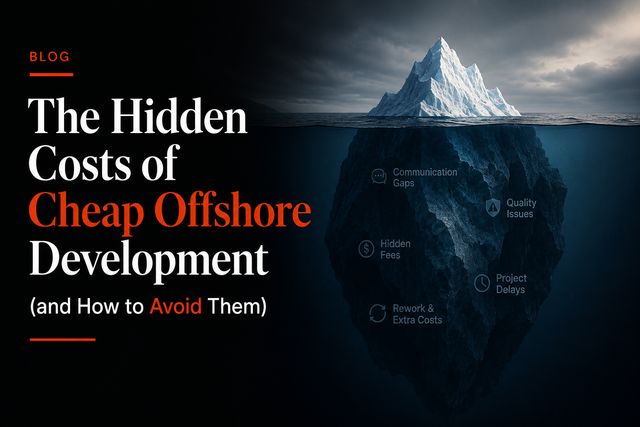
The honest caveat is that quality varies. A low rate can hide juniors, hand-offs and rework that cost more later. We cover those traps in the hidden costs of cheap offshore development. The way to avoid them is to confirm who actually does the work, talk to the engineers directly, and make sure you own the code.
A like-for-like cost comparison
To make the gap concrete, here is the same standard build, roughly 1,200 hours, costed across all three models. These are indicative 2026 figures, not quotes.
| Model | Effective rate | Build cost (1,200 hrs) |
|---|---|---|
| Local agency | $150/hr | ~$180,000 |
| In-house (loaded) | ~$90/hr equivalent | ~$108,000 + hiring time |
| Senior offshore | $20/hr | ~$12,000 + design and coordination |
The numbers are stark, but cost is not the only axis. Agencies can be worth it when you need zero involvement. In-house wins when the product is your core business for years. Offshore wins on price and speed when you want senior people building now without the overhead.
How to choose
Match the model to your stage and your appetite for involvement. A few honest rules of thumb:
- Early and budget-conscious? A senior offshore team gets you the most product for the money. Start there, validate, then decide.
- Product is your whole business and revenue is steady? Build an in-house core for the long term.
- Want a fully managed process and budget is not the constraint? A local agency removes the most work from your plate.
- Want both speed and control? Many founders use offshore to build and ship, then hire a small in-house core later.
Whatever you choose, insist on transparency. Ask who writes the code, what the rate actually covers and whether you own the result. We built our pricing around those answers: the rate is on the page, you can estimate your own build, and a real person gives you a precise figure in a 15-minute callback.
What we do differently
We run as a senior offshore team with no agency layers between you and the engineers. The rate is roughly $20 an hour, billed weekly, and you own the code from day one. Since 2015 and across 320,000+ project hours, we have shipped for US and UK founders who wanted senior delivery without senior prices. You can see how that maps to your project on our pricing page.
FAQ
Quick answers.
Is offshore development cheaper than a local agency?
Usually by a wide margin. A senior offshore team can start near $20/hour against $100–250/hour at a US or UK agency. For the same scope that often means a build that costs a quarter to a tenth as much, provided you work with seniors and avoid hidden middlemen.
When does hiring in-house make more sense?
Once you have steady, long-term work and a product that is core to your business, an in-house team gives you the most control. The catch is the true cost: salary is only about 60–70% of what each hire actually costs once you add benefits, recruiting, equipment and management.
What is the biggest hidden cost in each model?
For agencies it is overhead and account-management layers. For in-house it is the loaded cost beyond salary plus the time to hire. For offshore it is the risk of juniors hidden behind a senior pitch, which is why who you actually talk to matters.
Can I mix these models?
Yes, and many founders do. A common pattern is a senior offshore team to build and ship fast, then a small in-house core to own the product long term once revenue supports it.