Comparison
Build vs Buy: When to Build Custom Software
2 Jun 2026 · 8 min read · The Contrast
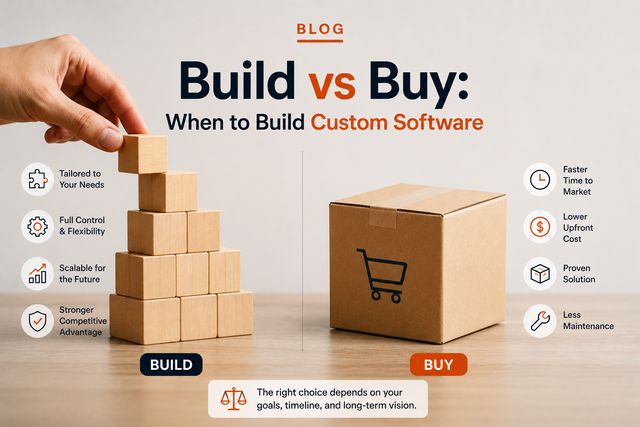
The honest rule for build vs buy software in 2026 is simple: buy when an off-the-shelf tool already fits and the need is generic, and build when the software is your competitive edge or no tool fits your workflow. Most companies should do both: buy your context, build your core. Here is a clear framework to decide, with the trade-offs spelled out.
Build vs buy at a glance
The decision usually comes down to whether the need is generic or core, how well existing tools fit, and how cost behaves over time. This table is a practical summary for founders.
| Factor | Buy (off-the-shelf) | Build (custom) |
|---|---|---|
| Best for | Generic, commodity needs | Core differentiators |
| Time to value | Fast, available now | Slower, built for you |
| Up-front cost | Low | Higher |
| Long-term cost | Subscriptions, lock-in | Owned asset, you maintain |
| Fit | What the vendor decided | Exactly your workflow |
Neither answer is universally right. The table tells you which trade-off you are making. If you have decided to build, your next decision is who builds it, covered in freelancers vs a dedicated offshore team.
When to buy
Buy when the need is generic and a tool already does it well. Email, payroll, accounting, CRM, helpdesk, analytics, these are solved problems with mature products, and building your own version almost never pays off. You would spend months rebuilding what you can switch on today, and then carry the maintenance forever.
Buying gets you to value fast and at a low up-front cost. The catch is that you accept the vendor's decisions about how the software works, and over time you pay in subscriptions and lock-in. For commodity needs that is a fair trade. The mistake is buying for your core, the thing that makes you different, and then bending your business to fit someone else's product.
When to build
Build when the software is your edge. If the product is the thing customers pay for, or the workflow is what makes you faster, cheaper or better than competitors, that belongs in software you own and control. No off-the-shelf tool is shaped exactly like your advantage, by definition.
Build, too, when existing tools force you to change how you work, when integration and data ownership matter, or when you are stitching together three half-fitting products with manual workarounds. At that point the "cheap" bought tools are quietly costing you in lost efficiency. Custom software is a higher up-front cost but an owned asset built for exactly your workflow. The smart way to start is small, with an MVP that proves the core before you invest further, which we cover in our cost to build an MVP guide.
The cost reality
Buying almost always wins on up-front cost, which is why it feels like the safe default. But the honest comparison runs over years, not months.
Bought software costs you per seat, every month, forever, plus the price of working around what it cannot do. Built software costs more to create, then becomes an asset you own and improve. For a commodity need, the subscription is cheaper than the build. For your core, the subscription, plus the lost efficiency of an imperfect fit, can quietly exceed the cost of building the right thing once. Decide on total cost over the life of the need, not the first invoice.
How to choose
Run each need through one question: is this generic, or is it your edge?
- Buy when the need is generic, a mature tool fits well, and you want value now.
- Build when the software is a core differentiator, no tool fits your workflow, or integration and data ownership are critical.
- Do both as a hybrid: buy commodity tools, build only the parts that make you different. This is what most healthy companies actually do.
The trap at both ends is the same: building what you should have bought wastes months, and buying what you should have built caps your advantage. When you do build, build it properly, with senior people and clear ownership, not the lowest quote.
How we approach it
We only build the parts worth building. We will tell you honestly when an off-the-shelf tool is the better answer, because a custom build that should have been a subscription helps no one. When the software is your edge, we build it end to end with a single owning team.
From MVPs to web, mobile and dedicated teams, our services cover the build with senior engineers you talk to directly, not an account manager, and pricing on the page from about $20/hour. We have run this model since 2015 across more than 320,000 project hours, so when you decide to build, you build it once and build it right.
FAQ
Quick answers.
Build vs buy software: which should I choose?
Buy when an off-the-shelf tool already fits and the need is generic, like email, payroll or CRM. Build when the software is your competitive edge or no tool fits your workflow. The rule of thumb: buy your context, build your core.
When is it worth building custom software?
When the software is the product or a core differentiator, when off-the-shelf tools force you to change how you work, or when integration and data ownership matter. If a tool does the job well, building it yourself rarely pays off.
Is buying always cheaper than building?
Up front, usually yes. Over time, not always. Per-seat subscriptions, lock-in and workarounds for missing features add up, and a tool that almost fits can cost more in lost efficiency than custom software would.
Can I do both?
Yes, and most companies should. Buy commodity tools for generic needs and build only the parts that are your edge. A hybrid approach keeps cost down while protecting what makes you different.