Industry
EdTech Product Development: What's Different
24 May 2026 · 8 min read · The Contrast
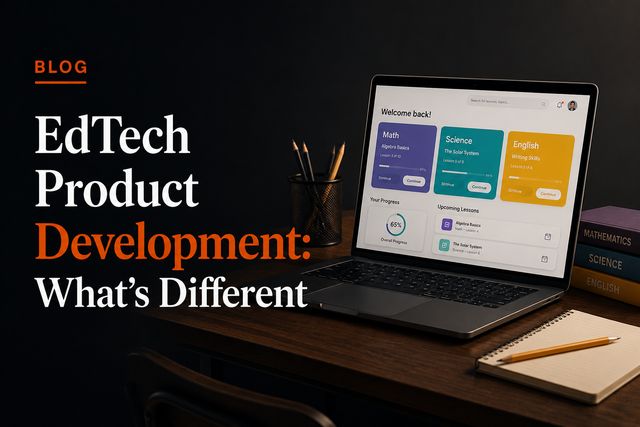
EdTech product development is different from ordinary SaaS because the software lives inside real institutions, serves several very different users at once, and handles data about learners, often minors, that demands real care. The technology is rarely the hard part. The hard part is modelling how teachers, students, evaluators and administrators actually work, and building something they trust. Here is what changes when you build for education.
Multiple roles, multiple interfaces
A consumer app usually has one kind of user. An EdTech platform almost never does. At a minimum you are building for learners, for the people who teach or assess them, and for administrators who run the institution. Each sees a different interface, has different permissions, and judges the product by different criteria.
This means role design is not a settings screen you add later. It is one of the first decisions you make, because it shapes navigation, data access and your entire permission model. A student should never see an evaluator's queue; an administrator needs an overview neither of them has. Get the roles right early and the rest of the product has a clear spine.
This is the same discipline we apply to any SaaS build: decide the structural questions before writing the data layer. In EdTech the roles are that structural question.
Workflows shaped by institutions, not individuals
Consumer software bends to the individual. EdTech bends to the institution: terms and semesters, exam windows, marking deadlines, grade boundaries, moderation. A feature that ignores the academic calendar will feel wrong no matter how polished it looks.
We saw this directly building Nova Mark, a platform that streamlines answer-paper checking and evaluator workflows for institutions. The technically interesting part was not rendering scripts on screen; it was respecting how evaluation actually happens, how papers are distributed, how second-marking and moderation work, how results are compiled. The product had to fit an existing process and make it faster, not replace it with something that ignored how the institution runs.
That is the core lesson of EdTech product development: you are digitising a process that already exists and matters. The right move is to study it closely, then remove the friction, not to impose a new workflow on people who cannot change theirs mid-term.
Accessibility is not optional
In education, accessibility is both an ethical baseline and frequently a legal requirement. Your users include people with visual, motor and cognitive differences, and the product has to work for all of them. That means proper keyboard navigation, sufficient colour contrast, screen-reader support, captions, and content that scales without breaking.
Accessibility is far cheaper to build in than to retrofit. Designing it from the start changes how you write markup and structure components, but it does not slow a competent team down. Bolting it on after launch usually means reworking the interface twice. The shared discipline here, build the hard requirement in from day one, is the same one we describe for privacy-first healthcare software.
Data privacy, especially for minors
EdTech routinely handles data about children, and that raises the bar. The principle is simple to state and demanding to honour: collect only what you genuinely need, restrict access strictly by role, and treat learner data as sensitive by default.
Practically, that means:
- Minimise collection. Do not gather data you have no clear use for.
- Restrict by role. Access to learner records should follow a clear, auditable permission model.
- Be explicit about consent and retention. Institutions and parents need to know what you hold and for how long.
- Plan for export and deletion. The ability to remove a learner's data cleanly is a feature, not an afterthought.
Privacy designed into the data model is durable. Privacy added under pressure after an incident is expensive and rarely complete.
Reliability when it matters most
EdTech has brutal peak loads. An assessment platform may be quiet for weeks, then carry an entire cohort on exam day. A learning platform spikes around deadlines. The system has to be most reliable exactly when most is at stake, because there is no "try again next week" for a missed exam.
That puts a premium on sensible architecture, real load testing before peak events, and monitoring that warns you before users do. It is unglamorous engineering, and it is the difference between a platform institutions adopt and one they quietly abandon after a bad results day.
Build small, but build it properly
None of this requires a large team. It requires a senior one that understands institutional workflows and takes privacy and accessibility seriously. With Nova Mark we shipped a focused, dependable evaluation platform with a small team that owned the product end to end, because we modelled the real evaluation process first and built carefully around it. You can see the rest of our range on the work page, from operations software to consumer mobility apps.
How we approach EdTech
We have built for education since 2015, and we treat EdTech as a domain with its own rules rather than generic SaaS with a school logo. A small senior team, billed from about $20 an hour, studies your real workflow, designs the roles and privacy model up front, and owns the build end to end. You talk to the engineers, not an account layer. If you are building for learners and institutions, see how we handled it with Nova Mark, then tell us how your process actually works, and we will build the software to fit it.
FAQ
Quick answers.
What makes EdTech product development different from normal SaaS?
EdTech has more user roles, stricter accessibility and privacy requirements, and workflows shaped by real institutions and academic calendars. The hard part is the people and process, not the technology.
What user roles does an EdTech platform usually need?
Most platforms need at least learners or students, teachers or evaluators, and administrators. Each role sees a different interface and has different permissions, so role design is a core early decision.
How do you handle student data privacy in EdTech?
Collect only what you need, restrict access by role, and treat data about minors as sensitive by default. Privacy must be designed into the data model, not added later.
Can a small team build a serious EdTech product?
Yes. A small senior team that understands institutional workflows can ship a focused, reliable platform. We did exactly that with Nova Mark for digital exam evaluation.