Offshore
How to Manage an Offshore Development Team Across Time Zones
16 Jun 2026 · 8 min read · The Contrast
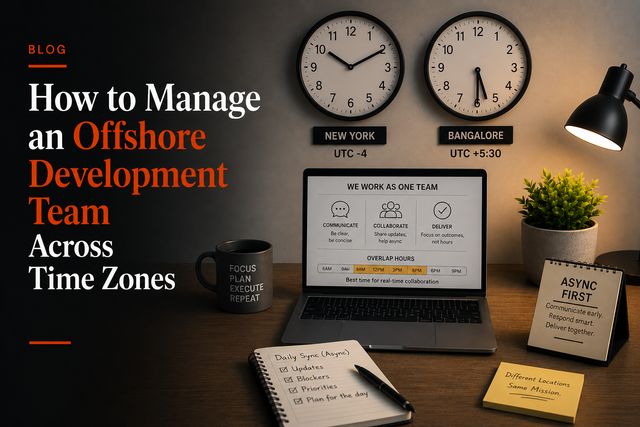
Learning how to manage an offshore development team across time zones is mostly about replacing constant supervision with clear direction and good habits. Set a daily overlap window for decisions, write everything else down so work runs while you sleep, hold a short daily check-in and a weekly demo, and judge the team on what ships, not on hours online. The time gap becomes an advantage, not a problem.
The mindset shift that makes it work
The founders who struggle with offshore teams usually try to manage them like an in-house team in the next room, expecting instant replies all day. The ones who succeed manage by outcomes. You agree what needs to be true by Friday, give the team room to get there, and check progress at set points. A senior offshore team needs direction and context, not a manager watching the clock.
This is far easier when the team genuinely owns the work. If you hired well, you have people who flag problems early and make sensible calls without waiting for you. If you are still hiring, our guide on how to hire offshore developers covers how to test for exactly that.
Use the overlap window deliberately
You do not need to share a full working day. You need a reliable two-to-four-hour window where everyone is awake at once. Protect it and use it for the things that are slow over text:
- Decisions that need back-and-forth
- Unblocking whatever is stuck
- Quick design or priority calls
- A short, human catch-up
For a US founder and an India team, this usually lands in the founder's morning and the team's evening. Pick the window, make it consistent, and keep it for live conversation rather than status reading.
Write everything down
The single biggest lever in remote, cross-time-zone work is writing things down. When a decision, a spec or a piece of context lives in a document instead of in someone's memory, work continues without you. Async-first means:
- Decisions are recorded where everyone can find them
- Tasks have enough detail to start without a meeting
- Questions get asked in writing early, not saved up for the next call
- Progress is posted at the end of each day so you wake up to an update
Done well, the time difference works for you. Work ships overnight and you review it in the morning. Done badly, you lose a full day to every misunderstanding.
The rhythm that keeps things on track
A simple cadence covers most of what management needs.
| Ritual | Frequency | Purpose |
|---|---|---|
| End-of-day update | Daily | See what shipped and what is blocked |
| Overlap check-in | Daily | Decisions and unblocking, live |
| Demo | Weekly | See working software, not status slides |
| Planning | Weekly or biweekly | Agree what ships next |
The weekly demo is the most important and the most skipped. Seeing the software run keeps everyone honest and surfaces misunderstandings while they are cheap to fix.
Measure outcomes, not hours
Resist the urge to track activity. Hours logged and messages sent tell you nothing about progress. What matters is whether the agreed work shipped and whether it works. Agree clear weekly outcomes, review them in the demo, and deal with slippage the moment it appears rather than at the end of the month. A team that consistently ships what it promised is well managed, whatever the clock says.
The tools that help
Keep the stack simple and use it consistently:
- A task board so everyone sees the work and its status
- A chat tool for quick questions during the overlap window
- A shared docs space for decisions and specs
- A video tool for demos and the harder conversations
The specific tools matter far less than the discipline of putting important things where the whole team can find them. The failure mode is always information trapped in one person's head, not the wrong app.
When management is barely needed
The truth most agencies will not tell you is that good management is mostly a function of good hiring and the right operating model. When you work directly with senior engineers who own the outcome, there is no account-manager layer distorting your messages, no junior team needing constant correction, and far less to manage in the first place. The hidden tax of those extra layers is real, and we cover it in the hidden costs of offshore development.
That is the model behind our dedicated development team: you talk to the people building your product, they run the daily rituals and updates themselves, and you spend your time deciding what to build rather than chasing status. For non-technical founders especially, that difference is enormous, and we cover the rest of it in offshore development for non-technical founders.
The short version
Managing across time zones is a discipline, not a daily grind. Protect an overlap window, write everything down, run a light daily-and-weekly rhythm, and judge the team on what ships. Hire seniors who own the work and most of the "managing" disappears. If you want a team that already works this way, our dedicated team runs these habits by default, and a 15-minute call with a real person is the fastest way to see it.
FAQ
Quick answers.
How do I manage an offshore development team across time zones?
Set a daily overlap window for live decisions, write everything else down so work continues asynchronously, run a short daily check-in and a weekly demo, and measure shipped outcomes rather than hours online. Good teams need direction, not supervision.
How much time-zone overlap do I need?
Two to four hours of shared working time is usually enough for daily decisions and unblocking. Beyond that, clear written updates cover the gap. The exact window matters less than the discipline of using it well.
How do I keep an offshore team accountable?
Accountability comes from clear goals, visible progress and regular demos, not from watching hours. Agree what ships each week, review it in a short demo, and address slippage early rather than at the end.
What tools do offshore teams use to stay aligned?
A task board for work, a chat tool for quick questions, a docs space for decisions, and a video tool for demos. The tools matter less than using them consistently so nothing important lives only in someone's head.