Careers
Manual vs Automation Testing: Which Should You Learn?
14 May 2026 · 7 min read · The Contrast
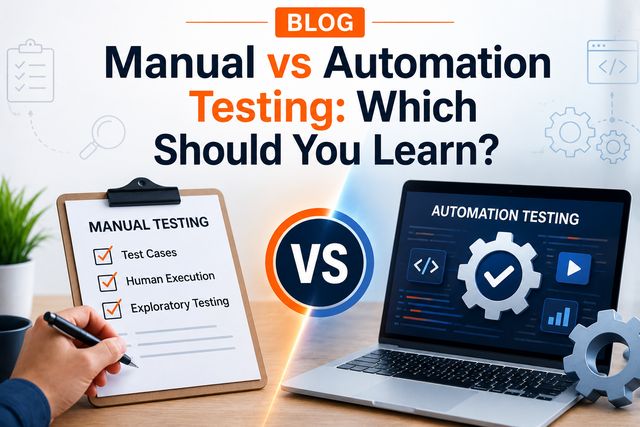
If you are deciding between manual and automation testing, the honest answer is that you should learn manual testing first and then add automation. They are not rivals. They are two stages of the same skill, and most working QA engineers in India use both every week. The order matters more than the choice.
What manual testing actually is
Manual testing means checking software the way a careful user would, without scripts running for you. You read the requirement, you try the feature, you try to break it, and you write down what went wrong clearly enough that a developer can fix it.
It sounds simple. It is not. Good manual testers are valuable because they think about what could go wrong that nobody planned for: the empty field, the slow network, the user who taps twice, the wrong date format. That instinct is the core of all testing, and you only build it by doing it by hand.
What automation testing actually is
Automation testing means writing code that checks the software for you, over and over, without a human repeating the same steps. If a login flow needs to be verified after every release, you write a script once and it runs in seconds every time.
Automation shines on repetitive, stable checks: regression suites, smoke tests, API checks. It does not replace human judgement. A script only finds the problems you told it to look for. It will never notice that a button looks ugly or that a flow feels confusing.
A side-by-side comparison
| Factor | Manual testing | Automation testing |
|---|---|---|
| Coding needed | Little to none | Some, in Java, Python or JavaScript |
| Best for | Exploratory, usability, new features | Regression, repetitive checks, APIs |
| Speed | Slower, one run at a time | Fast once written |
| Setup cost | Low, start today | Higher, scripts take time to build |
| Human judgement | High | Low, follows the script only |
| Entry barrier | Lower | A bit higher |
Why beginners should start with manual
There is a tempting shortcut: skip manual, jump straight to writing automation scripts because that is where the higher salaries are. It usually backfires.
If you do not understand how software fails, you will write automated tests that check the wrong things. You will confirm that the happy path works and miss the broken edge cases that actually matter. Manual testing teaches you what is worth automating in the first place.
Manual testing also lets you start contributing fast. You can write your first useful bug report in your first week. That early confidence keeps people going. Our Software Testing course is built in this order on purpose: fundamentals and manual testing first, then automation once the thinking is in place.
When to move into automation
Move into automation once you can do these without thinking twice:
- Write a clear, reproducible bug report.
- Design test cases from a requirement document.
- Spot the edge cases a feature is likely to break on.
- Understand the basics of how web apps and APIs work.
At that point automation stops being intimidating and starts being a natural extension. You already know what to test. Now you are just teaching a machine to do the boring, repeated parts so you can spend your time on the hard, interesting parts.
What the job market in India actually wants
Most QA listings in India today ask for both. A typical mid-level role wants someone who can run exploratory testing manually and also maintain a Selenium or Playwright suite. Pure manual roles still exist at the entry level, and pure automation roles exist at senior levels, but the broad middle of the market wants a blend.
This is good news for learners. It means you do not have to bet everything on one path. You build manual first because it is the foundation, then layer automation on top, and you end up qualified for the widest set of jobs. If you want to see how indicative pay changes as you add automation, read our guide to software tester salary in India.
A simple plan to learn both
Here is the path we would give a friend starting from zero:
- Learn testing fundamentals: test cases, bug life cycle, types of testing.
- Practise manual testing on real apps until bug reports come naturally.
- Learn just enough of one language, usually Java or Python.
- Pick one automation tool, Selenium or Playwright, and automate a small flow you already tested by hand.
- Add API testing basics and a few CI concepts.
If you are still at the very start and wondering whether you even need a degree or prior experience, our companion guide on how to become a QA tester walks through that.
The honest takeaway
Manual versus automation is the wrong framing. The real question is what to learn first, and the answer is manual, because it builds the judgement that makes automation worth anything. Learn to find bugs by hand, then teach a machine to find the predictable ones for you.
That progression, manual to automation, is exactly how we structure the Software Testing course at The Contrast Academy in Navi Mumbai, with project-based practice and placement support through our hiring partners.
FAQ
Quick answers.
Should I learn manual or automation testing first?
Start with manual testing. It teaches you how software breaks, how to write a clear bug report and how to think like a user. Once that base is solid, automation is much easier to pick up and you will write better automated tests.
Does manual testing have a future in India?
Yes. Every product still needs human judgement for exploratory testing, usability and edge cases that scripts miss. Most QA jobs in India today expect both manual skills and at least basic automation, not one without the other.
Do I need to know coding for automation testing?
You need some coding, but less than people fear. Automation tools like Selenium and Playwright are usually driven with Java, JavaScript or Python. You can learn enough to be productive without becoming a full developer.
Can I get a testing job knowing only manual testing?
You can, especially at the entry level, but you will have more options and better pay if you add automation later. Treat manual as the starting point, not the finish line.