Comparison
Offshore vs Onshore vs Nearshore Development: Which Is Right for You?
18 Jun 2026 · 8 min read · The Contrast
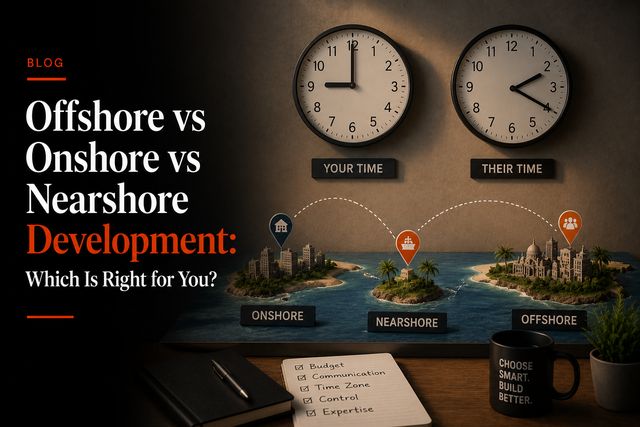
Choosing between offshore vs onshore vs nearshore development comes down to three trade-offs: cost, time-zone overlap and the size of the talent pool. Onshore is closest and priciest, nearshore sits in the middle, and offshore is the cheapest with the widest talent but the biggest time gap. The right choice depends on your stage, budget and how well a team communicates.
The three models in plain terms
- Onshore means building with a team in your own country. Same time zone, same culture, highest cost.
- Nearshore means a nearby country in a similar time zone, for example Mexico for a US company or Poland for the UK. Moderate cost, good overlap.
- Offshore means a distant country, most often India, chosen for senior talent at a much lower rate. Largest saving, biggest time difference.
None of these is "best" in the abstract. They are different points on the same trade-off curve.
Side by side
| Factor | Onshore | Nearshore | Offshore |
|---|---|---|---|
| Indicative 2026 rate | $80–$250/hr | $40–$80/hr | $20–$25/hr |
| Time-zone overlap | Full | High | Partial |
| Talent pool | Small, expensive | Medium | Very large |
| Cultural distance | None | Low | Manageable |
| Best for | Heavily regulated, on-site needs | Real-time collaboration | Cost-sensitive product builds |
These rates are indicative 2026 estimates, not quotes. The numbers move with seniority and country, but the shape holds: offshore is the cheapest by a wide margin, and the saving is what funds a longer runway for most founders.
Cost: the honest comparison
For an early-stage company, cost decides how long you can keep building before you run out of money. An offshore team at $20 to $25 an hour gives you two to ten times the engineering hours per dollar compared with onshore. Over a year, that is the difference between shipping once and shipping, learning and shipping again.
The thing to remember is that the cheapest invoice is not always the lowest total cost. Junior teams, hand-offs and rework can eat the saving. We cover that trap in the hidden costs of offshore development. The goal is senior offshore, which gives you onshore-grade work at offshore prices.
Time zones: smaller problem than it looks
The most common worry about offshore is the time gap. In practice it is a process question, not a geography one. A well-run offshore team:
- Keeps a daily overlap window for live calls and quick decisions
- Writes clear async updates so you wake up to progress, not silence
- Hands off work that runs while you sleep, then reports what shipped
Run well, the time difference becomes an advantage: work continues around the clock. Run badly, it becomes a black hole. The difference is the team's discipline, which is exactly what you test before you commit, as we explain in how to hire offshore developers.
Talent: where offshore wins quietly
The deeper reason founders go offshore is not just price, it is access. The onshore senior-engineer pool is small and fought over. India alone produces an enormous number of skilled engineers each year, which means you can hire genuinely senior people without competing against funded startups for the same handful of locals.
This is also where the offshore-versus-nearshore question gets interesting. Both are cost-effective, but the talent depth and the maturity of the delivery model differ by region. We compare two of the biggest in India vs Eastern Europe software outsourcing.
Which model fits which situation
Choose onshore when the work demands on-site presence, sits in a heavily regulated domain that requires it, or when budget genuinely is not a constraint.
Choose nearshore when real-time collaboration across the whole day is non-negotiable and you can accept a higher rate for the overlap.
Choose offshore when you want the most product for your budget and you are willing to hire carefully for communication and seniority. For most startups and founders, this is the model that stretches the runway furthest.
In reality, many companies blend models: a founder onshore, the build offshore. That works well when the offshore team owns the work end to end rather than waiting for instructions.
Making offshore feel onshore
The best offshore experience removes the things that make "offshore" feel risky. No account managers in the middle, no junior bait-and-switch, no week-long silences. You talk directly to the senior engineers building your product, you get a real-person callback within minutes, and the team owns the outcome rather than ticking off tasks.
That is the model we run as a dedicated development team: senior India-based engineers for US and UK founders, transparent rates from around $20 an hour, and end-to-end ownership with no hand-offs. If you are weighing the three models, the fastest way to decide is a short call. Tell us your scope and we will tell you honestly whether offshore is the right fit, and you can compare it against the dedicated team option with real numbers.
FAQ
Quick answers.
What is the difference between offshore, onshore and nearshore development?
Onshore means hiring in your own country, nearshore means a neighbouring country in a similar time zone, and offshore means a distant country, usually for lower cost. The trade-off is between price, time-zone overlap and the size of the talent pool.
Is offshore development cheaper than nearshore?
Usually yes. Offshore rates in India run around $20 to $25 an hour in 2026, against $40 to $80 nearshore for a US client and $80 to $250 onshore. The saving is large, but only worth it with a senior team that communicates well.
Does the time-zone gap actually matter?
It matters less than people think when the team runs an overlap window and writes things down. A few hours of shared time plus clear async updates covers most needs. A team that disappears for a full day is a process problem, not a geography problem.
Which model is best for a startup MVP?
For most early-stage founders, offshore gives the longest runway because the cost is lowest. The key is hiring senior people with strong communication so you get onshore-level quality at offshore prices.