Careers
Bootcamp vs Degree vs Self-Taught: How to Learn to Code in India
16 May 2026 · 8 min read · The Contrast
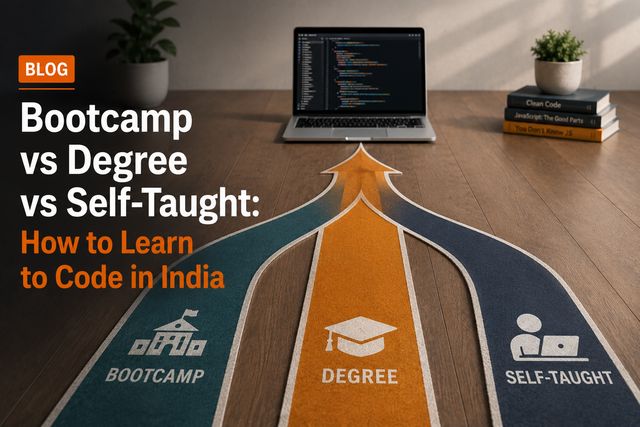
Bootcamp vs degree vs self-taught comes down to three honest trade-offs: time, cost, and how you learn best. There is no single right answer for learning to code in India. A degree gives depth and a credential, a bootcamp gives speed and structure, and self-teaching gives freedom but demands real discipline. Here is how to choose.
The three paths at a glance
| Path | Time | Cost | Best for |
|---|---|---|---|
| Degree (BTech, BCA, MCA) | 3-4 years | High | Those wanting deep theory and a formal credential |
| Bootcamp / focused course | Several months | Moderate | Those wanting a fast, structured, job-oriented path |
| Self-taught | Varies, often longer | Low | Disciplined, self-driven learners on a tight budget |
None of these is "better" in the abstract. The right one depends on your time, your money, and how well you learn without someone setting the pace.
The degree path
A degree gives you depth: data structures, operating systems, networks, and the theory behind how software works. That foundation is genuinely useful, and some companies still filter on it.
The trade-offs are real, though. It takes three to four years, costs the most, and many degree courses in India are light on practical, job-ready skills. Plenty of graduates finish with a certificate but no projects they can show in an interview. If you take this path, treat the degree as the foundation and build real projects on top of it yourself.
The self-taught path
Self-teaching is the cheapest route, and many working developers got in this way. The internet has everything you need for free. What it does not give you is structure, feedback, or accountability.
The honest challenges:
- No clear path. You spend a lot of time deciding what to learn next instead of learning.
- No feedback. You cannot easily tell if your code is good or your habits are bad.
- No team experience. This is the biggest gap. Real jobs are about Git, code reviews, and shipping with others, and you cannot fully practise that alone.
- Motivation. Staying consistent for months with no one expecting anything is hard.
Self-teaching works, but it usually takes longer, and the people who succeed at it are unusually disciplined.
The bootcamp or focused course path
A good course sits between the two. It gives you the structure of a degree without the years, and the feedback and team experience that self-teaching lacks. The trade-off is cost, which is higher than self-teaching but far lower than a degree.
The catch is that quality varies. A weak course is just expensive tutorials. A strong one is project-based, taught by people who build for a living, and backed by genuine placement support. Before paying for any program, check:
- Is it project-based? You should leave with real, deployed work, not just notes. Our guide to portfolio projects that actually get you hired explains why this matters.
- Who teaches it? Working engineers, or just presenters reading slides?
- Is placement support real? Ask about actual hiring partners, not vague promises.
- Does it simulate a team? Git, code reviews, and sprints should be part of it.
This is the model our courses with placement are built on: task-based learning, live project exposure, mentorship from working engineers, and placement support through 50+ hiring partners. We have used it to train and place 100+ people since 2015, and we teach in English, Hindi, and Marathi so language is never the barrier.
How to actually choose
Ask yourself three honest questions.
- How much time do I have? If you need to start earning within a year, a focused course or self-teaching beats a multi-year degree.
- What is my budget? Self-teaching is cheapest; a degree is the biggest investment; a course is in between.
- How do I learn? If you are highly self-driven, you can teach yourself. If you do better with structure, deadlines, and feedback, a course or degree suits you.
You can also combine paths. Many people do a degree and a focused course, or teach themselves the basics and then join a course to get team experience and placement support.
What every path has in common
Whichever route you pick, the same things decide whether you get hired: real projects you can explain, the ability to work in a team, and interview skill. The path is just the vehicle. This is also why the next step after any of them is the same, and why getting placed after a coding course deserves its own plan. If you are weighing your options in the Mumbai region, our overview of the best software courses with placement in Navi Mumbai is a useful next read.
The honest summary: there is no shortcut, but there is a path that fits your time, money, and learning style. If structure and placement support matter to you, our courses with placement are designed for exactly that.
FAQ
Quick answers.
Is a degree necessary to become a developer in India?
No. Many working developers in India do not have a computer science degree. Employers increasingly hire on the strength of your projects and how you perform in interviews. A degree helps in some companies, but it is not the only way in.
Are coding bootcamps worth it in India?
They can be, if the program is project-based and offers genuine placement support. A good bootcamp saves time by giving you structure and feedback. Check what is actually taught and whether real hiring partners are involved before you commit.
Can I become a developer fully self-taught?
Yes, and many people do. It is the cheapest path but also the hardest, because you have to build your own structure, get feedback, and stay motivated alone. It usually takes longer, and the biggest gap is real team experience.
Which is faster: a bootcamp or self-teaching?
A focused bootcamp is usually faster because the structure and mentorship remove guesswork. Self-teaching can work but often takes longer, since you spend time figuring out what to learn next and lack someone to review your work.