Careers
Portfolio Projects That Actually Get You Hired
18 May 2026 · 7 min read · The Contrast
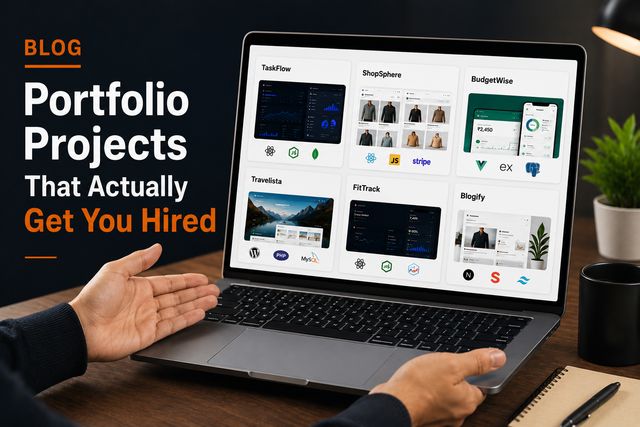
The portfolio projects to get hired as a developer are real, deployed applications you can explain end to end, not tutorial clones everyone else has built. Hiring managers do not count projects; they question them. Here is what to build, how to present it, and the mistakes that quietly cost people offers.
Why your portfolio matters more than your resume
For a first job, you usually have no work experience to point to. Your portfolio is the substitute. It answers the only question a hiring manager really has: can this person build something that works? A resume claims you can. A working, deployed project proves it. This is why we tell every learner that proof of work beats a longer resume, especially in the early years when your salary depends heavily on what you can demonstrate.
What makes a project worth showing
A good portfolio project has four qualities.
- It is complete. It does one thing properly, from start to finish, rather than three things halfway.
- It is deployed. A recruiter can open a live link in seconds. Code that only runs on your laptop does not count.
- It solves a real problem. Even a small one. A tool you would actually use beats an abstract demo.
- You can explain every decision. Why this database, why this structure, what you would change next time.
That last point is the one most people miss. The project is not the achievement. Being able to talk through it is.
Project ideas that stand out
You do not need an original startup idea. You need to build familiar things well, with your own decisions layered in.
| Project type | Why it works | What to add to stand out |
|---|---|---|
| Task or expense tracker | Shows CRUD, auth, and a clean data model | Add filtering, charts, and a deployed live link |
| Booking or scheduling app | Demonstrates real-world logic and edge cases | Handle conflicts, time zones, and confirmations |
| API-driven dashboard | Proves you can consume and display data | Add caching, error states, and loading states |
| Small e-commerce flow | Covers cart, checkout, and state management | Integrate a real payment sandbox |
| A tool you actually need | Shows initiative and product thinking | Solve a problem from your own daily life |
The pattern is the same across all of them: take a known idea, build it properly, deploy it, and make a few decisions of your own that you can defend.
Turn a tutorial into something real
There is nothing wrong with starting from a tutorial. The problem is stopping there, because every other applicant followed the same one. To turn a tutorial into proof of skill:
- Build it once by following along, so you understand the parts.
- Then change the idea: a different domain, a new feature, a different data model.
- Add something the tutorial skipped, like proper error handling or tests.
- Deploy it and write a short README explaining what you did and why.
Now it is yours, and you can talk about the choices you made instead of the steps you copied.
How to present your portfolio
Building the projects is half the work. Presenting them well is the other half.
- Write a clear README for each project: what it does, how to run it, what you learned, and a live link at the top.
- Pin your best two or three repositories so they are the first thing a visitor sees.
- Keep the code readable. Clean, well-named code signals that you would be easy to work with.
- Have a 60-second explanation ready for each project, because you will be asked in the interview.
A messy portfolio with great code still loses to a tidy one a recruiter can navigate in under a minute.
Mistakes that quietly cost offers
- Ten unfinished projects instead of three complete ones. Depth wins.
- No live links. If a recruiter has to clone and run it, most will not.
- Copied tutorials with no changes. They blend into every other application.
- Code you cannot explain. If you used code you do not understand, it will surface in the interview and undo the good impression.
How we approach this at the academy
Project-based learning is the core of how we teach. In the Full-Stack course, you build real applications in a team setting, with code reviews and live project exposure, so your portfolio is genuine work rather than isolated exercises. That experience, combined with placement support through 50+ hiring partners, is what we have used to train and place 100+ people since 2015. If you want to see the full learning path, the 2026 full-stack roadmap lays it out, and our Full-Stack course is built to produce exactly the kind of portfolio that gets you hired.
FAQ
Quick answers.
How many projects should be in a developer portfolio?
Two or three strong, complete projects are better than ten small ones. Hiring managers want depth they can question you on, not a long list of half-finished tutorials. Make each project something you can explain end to end.
Do tutorial projects count in a portfolio?
A tutorial you simply copied does not stand out, because every other applicant has the same one. Take the idea further: add a feature, change the data model, deploy it, and make decisions of your own. That turns a tutorial into proof of skill.
Should I deploy my portfolio projects?
Yes. A live link that a recruiter can open in seconds is far more convincing than code sitting in a folder. Deploying also proves you understand how an app actually runs in the real world, which is part of the job.
What if I have no work experience?
Projects are how you show ability without a job. A few real, deployed applications you built and can defend often carry more weight than experience listed on paper that you cannot speak to in detail.