Cost
The Cost of Maintaining Software After Launch
9 Jun 2026 · 7 min read · The Contrast
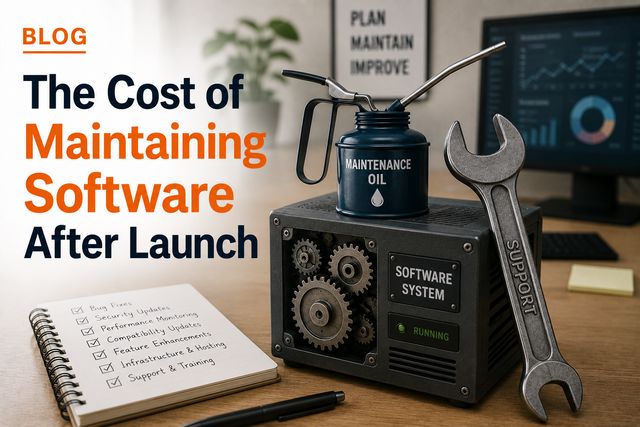
The cost of maintaining software after launch is typically 15 to 20 percent of the original build cost per year, covering hosting, security updates, bug fixes and small improvements. A $40,000 product usually costs $6,000 to $8,000 a year to keep healthy. Maintenance is not optional upkeep you can skip, it is what stops a working product from slowly breaking. Here is the honest breakdown.
Why software needs maintenance
Software does not sit still after launch, because everything around it keeps moving. The operating systems, browsers, libraries and third-party services your product depends on all update on their own schedules. Security threats evolve. Your users find edge cases your testing missed. Maintenance is the work of keeping the product aligned with a world that changes underneath it.
Skip it, and a product that worked perfectly at launch degrades. A payment integration breaks when the provider updates its API. A login stops working after a browser change. A known vulnerability goes unpatched. None of these are dramatic on day one; they accumulate into an expensive rebuild.
What annual maintenance actually costs
As a rule of thumb, budget 15 to 20 percent of the build cost per year. Where you land in that range depends on how complex and busy the product is.
| Product type | Build cost | Annual maintenance (15–20%) |
|---|---|---|
| Simple app | $25,000 | $3,750–$5,000 |
| Standard SaaS or app | $50,000 | $7,500–$10,000 |
| Complex platform | $100,000 | $15,000–$20,000+ |
These are indicative 2026 figures, not quotes. High-traffic products, or ones with strict uptime and compliance needs, sit at the top of the range or beyond. You can size your own project on our pricing page and cost calculator, and factor maintenance in from the start as we recommend in how to budget for a software project.
Where the maintenance budget goes
Maintenance is several distinct kinds of work, not one. Understanding the split helps you judge whether a maintenance quote is fair.
| Work | Share of maintenance budget |
|---|---|
| Hosting and infrastructure | 20–30% |
| Security and dependency updates | 20–30% |
| Bug fixes and support | 20–30% |
| Small improvements | 20–30% |
The exact mix shifts over time. Early on, bug fixes dominate as real usage surfaces issues. Later, the balance tilts toward security updates and small improvements that keep the product competitive.
The hidden costs to watch
Maintenance is also where some providers quietly recover margin. A few patterns to watch for, related to the traps we cover in the hidden costs of cheap offshore development:
- Lock-in. If you do not own the code or the infrastructure, you cannot move, and your maintenance bill is whatever they decide.
- Vague retainers. A flat monthly fee with no visibility into hours can mean you pay for time that is not spent.
- Neglected updates. Some providers bill a retainer but defer the unglamorous update work, leaving you exposed.
- Re-quoting fixes. Bugs from the original build should not arrive as new paid line items.
The protection is the same as for the build: own your code, get a visible rate, and know who is doing the work.
How to keep maintenance affordable
Steady, small maintenance is far cheaper than fixing a neglected codebase. The goal is to spread the work out, not to let it pile up. Practical ways to keep the cost sensible:
- Maintain continuously. Small, regular updates cost a fraction of a big catch-up later.
- Own your code and infrastructure. Ownership keeps you free to choose who maintains it and on what terms.
- Use managed services. Managed hosting, databases and auth reduce the maintenance surface you pay to look after.
- Keep dependencies current. Updating little and often avoids the painful, expensive jump across several major versions.
- Separate upkeep from features. Budget them apart so feature work does not crowd out the maintenance that protects what you shipped.
This is how we run maintenance and support: visible hours, your code stays yours, and a senior engineer who knows the product rather than a ticket queue. You only pay for the work that actually happens.
What our maintenance pricing looks like
A senior engineer with us starts at about $20 an hour, and maintenance is billed for the hours used rather than a black-box retainer. For most products that works out to the 15 to 20 percent annual range, often at the lower end because senior engineers fix things once and keep dependencies current rather than letting problems compound.
The same maintenance from a US or UK agency, where senior time runs $100 to $250 an hour, costs many times more for identical work. We do not hide the number: the rate is on our maintenance and support page, and a real person will give you a precise figure in a 15-minute callback. Since 2015 and across 320,000+ project hours, we have kept products healthy long after launch by treating maintenance as steady craft, not an afterthought.
FAQ
Quick answers.
How much does it cost to maintain software after launch?
Plan for 15–20% of the original build cost per year. A $40,000 build typically costs $6,000–$8,000 a year to maintain, covering hosting, security updates, bug fixes and small improvements. Complex or high-traffic products sit higher.
Why does software need maintenance at all?
Software runs on platforms that keep changing. Operating systems, browsers, libraries and third-party APIs update constantly, and security threats evolve. Without maintenance, a working product slowly breaks and becomes vulnerable.
Can I skip maintenance to save money?
You can defer it, but it usually costs more later. Skipped updates pile up into expensive rebuilds, security holes and outages. Steady, small maintenance is far cheaper than fixing a neglected codebase.
What is the difference between maintenance and new features?
Maintenance keeps what you have working: updates, fixes, security and uptime. New features add capability. Both matter, but budget them separately so feature work does not crowd out the upkeep that protects what you already shipped.