Cost
How to Budget for a Software Project as a Startup
10 Jun 2026 · 8 min read · The Contrast
To budget for a software project as a startup, size the build by scope and team rate, add design, QA and project management on top of raw engineering, keep a 15–20% contingency, and reserve money for hosting and maintenance after launch. Most first versions land between $15,000 and $60,000, but the budget that survives contact with reality is the one with a buffer and a plan for what comes next.
Start with the build, not the wish list
Every budget begins with scope. The trap is budgeting for everything you can imagine instead of what you need to launch. Write down the smallest version that delivers your core value, then price that. The discipline of cutting scope is the single biggest lever on cost, which we cover in detail in the cost to build an MVP.
Once you have a tight scope, the build cost is mostly engineering hours times your team's rate. That rate is the largest variable in the whole budget, which is why the model you choose matters so much. We compare the options in agency vs in-house vs offshore cost. You can size your own scope against real rates on our pricing page and cost calculator.
What a full software budget actually includes
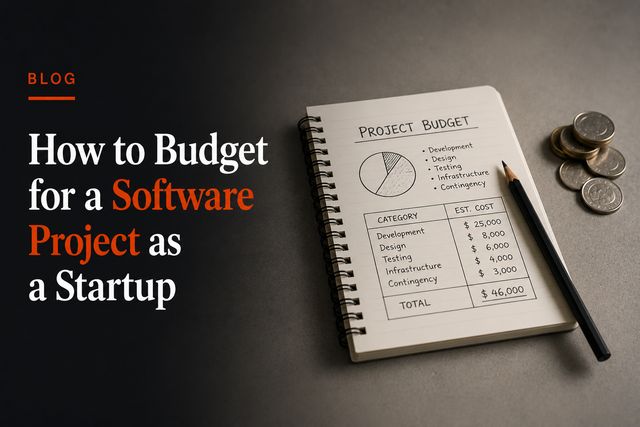
Founders often budget only for engineering and get surprised by the rest. A realistic budget has several parts. Here is how a typical first-version budget breaks down.
| Budget line | Share of total | What it covers |
|---|---|---|
| Engineering | 55–65% | Front end, backend, integrations |
| Design | 12–18% | UX, UI, prototypes |
| QA and testing | 8–12% | Finding and fixing issues before launch |
| Project management | 5–10% | Planning, coordination, communication |
| Contingency | 15–20% | The scope changes you cannot predict |
The contingency is not padding, it is realism. Scope shifts the moment real users touch the product. A buffer is the difference between adjusting course and stalling.
Plan for the costs that come after launch
A common, expensive mistake is treating launch as the finish line. It is the start of the real work. Your budget needs a line for what happens after.
Ongoing costs usually include:
- Hosting and infrastructure. Scales with your user count, often $50–$500/month early on.
- Third-party services. Payments, email, maps, auth and analytics each carry fees.
- Maintenance. Bug fixes, security updates and small improvements, typically 15–20% of the build cost per year.
- Iteration. The features you add once users tell you what they actually want.
Reserve money for these from the start. If you spend the entire budget on the first build, you have no room to act on what launch teaches you, and that learning is the whole point.
A worked example
Say you are building a standard web app with accounts and payments. Here is how a realistic budget might come together with a senior offshore team at around $20/hour.
| Item | Estimate |
|---|---|
| Engineering (~1,000 hrs) | ~$20,000 |
| Design | ~$3,000 |
| QA and testing | ~$1,500 |
| Project management | ~$1,500 |
| Contingency (18%) | ~$4,700 |
| Build total | ~$30,700 |
| First-year hosting + services | ~$2,000 |
| First-year maintenance (~18%) | ~$5,500 |
The same build through a US or UK agency, where senior time runs $100 to $250 an hour, would routinely cross $120,000 before contingency. The line items are the same; the rate behind them is what moves the total. These are indicative 2026 figures, not quotes.
How to keep the budget under control
A budget holds when you control scope and visibility, not when you simply spend less. Practical rules that work:
- Bill weekly, not in big milestones. You see cost accrue in real time and can stop or steer at any point.
- Cut features, not quality. A smaller, well-built product beats a large, fragile one.
- Insist on a visible rate. If you cannot see the hourly rate, you cannot forecast the budget.
- Avoid hand-offs. Every account-management layer you remove is money back in the build.
- Review scope at each step. Small course corrections are cheap; late rebuilds are not.
This is how we run projects: a small senior team, weekly billing, and a price you can see before you commit. You talk to the engineers building it, not an account manager relaying messages.
How to get a number you can plan around
The fastest way to a budget you can trust is a short, specific conversation about scope. Bring your core feature list, your launch goal and your timeline, and the estimate gets accurate quickly. A vague brief produces a vague number that will not survive the project.
We do not hide the figure behind a "request a quote" wall. The rate is on our pricing page, you can estimate your own build with the cost calculator, and a real person will give you a precise figure in a 15-minute callback. Since 2015 and across 320,000+ project hours, we have learned that the founders who budget for the whole journey, not just the build, are the ones who ship and keep shipping.
FAQ
Quick answers.
How much should a startup budget for its first software build?
Most startups should plan $15,000–$60,000 for a first version, depending on scope and team rate. Keep a 15–20% contingency on top, and set aside ongoing money for hosting and maintenance after launch rather than spending the whole budget on the build.
How much contingency should I keep?
Keep 15–20% of the build cost as contingency. Scope almost always shifts once real users see the product, and a buffer means a change of direction does not derail the whole project.
Should I budget for maintenance from the start?
Yes. Plan for ongoing maintenance of roughly 15–20% of the build cost per year, plus hosting and third-party service fees. Software is never truly finished at launch.
What is the most common budgeting mistake founders make?
Spending the entire budget on the first build with nothing left for iteration. The first version teaches you what to fix, and you need money in reserve to act on what you learn.