Cost
Fixed-Price vs Hourly Software Development: Which Actually Protects You
30 Jul 2026 · 8 min read · The Contrast
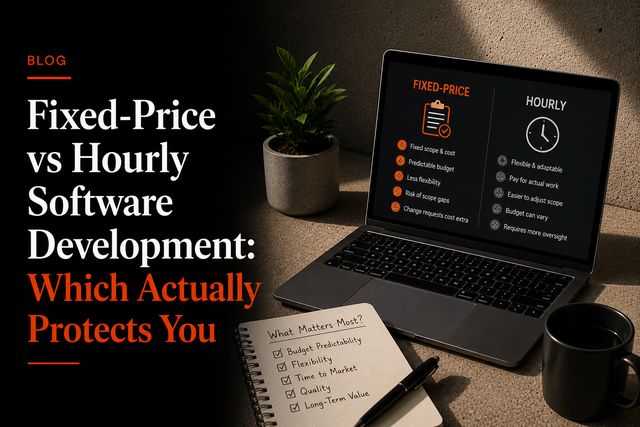
Neither model is honest or dishonest on its own — the honesty is in whether it fits your project. Fixed-price protects you when the scope is genuinely clear. Hourly protects you when the work is still evolving. The trap is paying for a fixed price on a fuzzy project, where the "certainty" you bought is mostly a risk buffer you'll never see the inside of. Here's how to tell which one is actually working in your favour.
What each model really is
| Fixed-price | Hourly | |
|---|---|---|
| You pay for | An agreed outcome | Time actually worked |
| Best when | Scope is clear and stable | Scope is evolving or being discovered |
| Who carries the risk | The team (so they price for it) | Shared, transparently |
| Main danger | A padded buffer + costly change orders | Time running without visible progress |
Both are legitimate. The problem is never the model — it's using the wrong one for where your project actually is.
The hidden cost of a fixed price
A fixed price sounds safer, and sometimes it is. But someone has to carry the risk of the unknown, and on a fixed-price deal that someone is the team — so they build a buffer into the number to protect themselves. When your requirements are crisp, that buffer is small and the certainty is worth it. When your requirements are fuzzy, the buffer is large, and you pay for risk that may never materialise.
There's a second edge to it. Because the team is now protecting a fixed number, every change becomes a negotiation. On a badly written contract, that means expensive, one-sided change orders for anything not spelled out on day one — which is a lot, on a project you're still figuring out. This is the same dynamic behind so much of what you actually pay for in an agency invoice: risk and overhead priced in, whether or not you needed them.
The hidden cost of hourly
Hourly isn't automatically the honest choice either. Its danger is the opposite: time that runs without visible progress. Paid by the hour, a team with no accountability has no reason to move fast. That's why hourly only protects you when it comes with weekly demos, weekly billing and the ability to stop — so you're always seeing what your money bought and can walk if you're not.
Done right, hourly is the cheaper and fairer model for evolving work, because you never pay for a buffer against unknowns — you just pay for the work, as we lay out in our true cost comparison of agency, in-house and offshore.
How to choose
Ask one question: how clear is the scope, honestly?
- Clear and stable — you know exactly what "done" looks like, down to the screens. Take the fixed price. The buffer is small and the certainty is real.
- Still evolving — you're testing an idea, and the shape will change as you learn. Go hourly, with weekly demos and the right to stop. Don't pay for a fixed number built on guesses.
- Somewhere between — start hourly while the scope firms up, then fix the price once it's real. You get flexibility while you're learning and a committed number once you're not.
How we do it
We'll tell you which model is honestly cheaper for you, not which is more billable for us. Often that means starting hourly, then fixing the price once the scope has settled — and when we do quote a fixed price, it's built from our published $20/hour rate, not a mystery number with a buffer baked in. Either way you're billed weekly, you see working software weekly, and any scope change is priced in writing before the work starts.
That's the whole idea of doing this in black and white: the model, the rate and the changes are all on the page, so whichever one fits your project is the one that protects you. If you'd rather have the whole build owned end to end for one written price, that's what our fixed-price projects are for.
FAQ
Quick answers.
Is fixed-price or hourly cheaper for software development?
Fixed-price is usually cheaper when the scope is genuinely clear, because you get one committed number. Hourly is usually cheaper when the scope is still evolving, because you don't pay for padding against unknowns. The honest answer depends on how well-defined your project is — a good team will tell you which fits.
Why do fixed-price quotes cost more sometimes?
A fixed price has to include a risk buffer. The team is taking on the uncertainty, so they pad the number to protect themselves against scope creep. When your requirements are clear that buffer is small; when they're fuzzy it can be large, and you pay for risk that may never materialise.
What happens if the scope changes on a fixed-price project?
On an honest engagement, changes are scoped and priced in writing before any extra work starts — you approve or decline, and the original quote never silently inflates. Be wary of fixed-price contracts where every change triggers an expensive, one-sided change order.
Which model is better for an MVP or a startup?
Many early products start hourly because the scope is still being discovered, then move to a fixed price once the shape of the build is clear. This gives you flexibility while you're learning and a committed number once you're not.