Careers
How to Become a Product Manager in India (No Experience)
6 May 2026 · 7 min read · The Contrast
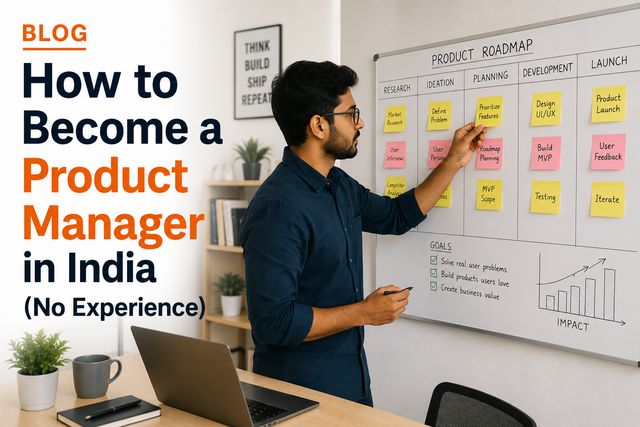
To become a product manager in India with no experience, the honest path is: build the core skills, create proof that you can think like a PM, network into the role, and target realistic first jobs like associate product manager positions or startups. There is rarely a direct jump into a senior PM seat, but the entry routes are well-worn and open to people from many backgrounds. Here is how it works.
What a product manager actually does
A product manager decides what to build and why, then works with engineering, design, and business teams to ship it. You are not the boss of those teams; you are the person who keeps everyone aligned on the right problem. The core of the job is:
- Understanding users and their problems
- Deciding what to build next and what to drop
- Writing clear requirements and priorities
- Working closely with engineering and design
- Using data to check whether decisions worked
You do not need to code or design yourself. You need to understand both well enough to make good calls and earn the team's trust.
Step 1: Build the core skills
Before chasing a title, build the actual skills. The ones that matter most early:
| Skill | Why it matters |
|---|---|
| User understanding | Everything starts with the right problem |
| Prioritisation | Saying no well is most of the job |
| Communication | You align people without authority |
| Basic data analysis | Decisions need evidence, not opinions |
| Working with tech and design | You speak both languages |
These are learnable. Our Product Management course is structured around them with real, project-based work, because reading about prioritisation is very different from defending a real roadmap call.
Step 2: Create proof of product thinking
This is what separates people who get interviews from people who do not. With no job title yet, you build evidence:
- Take a product you use and write a teardown — what works, what does not, what you would change and why.
- Define a feature end to end — problem, users, solution, how you would measure success.
- Run a small real project — even a side project where you decide priorities and ship something.
The point is to show you can think in problems, users, and trade-offs, not just have opinions. A short portfolio of two or three of these is more convincing than any certificate alone.
Step 3: Use your current background as a bridge
Most PMs do not start as PMs. They cross over from an adjacent role. Look at where you already are:
| You are now | Bridge into product |
|---|---|
| Engineer / developer | Technical PM roles |
| Designer | Product design to product roles |
| QA / tester | Strong process and user empathy |
| Business analyst | Closest natural fit |
| Marketing / sales | Growth and customer-facing products |
| Support | Deep user knowledge |
If you can move toward product within your current company, that internal transfer is often the easiest first step. If not, your background still shapes which PM roles you should target.
Step 4: Target the right first job
With no experience, aim where the door is actually open:
- Associate Product Manager (APM) programmes, built for entry-level talent
- Early-stage startups, where they value a generalist who gets things done
- Internal transfers from a role you already hold
- Product operations or analyst roles that sit next to product
Applying only to senior PM roles at large product companies is the most common reason people get stuck. Start where beginners are welcome, then grow.
Step 5: Network and learn the language
Product hiring leans heavily on referrals and conversations. Talk to working PMs, ask how they got in, and learn the vocabulary — roadmaps, MVPs, metrics, sprints. In India, being able to communicate clearly in English, Hindi, or Marathi across mixed teams is a real asset, since you spend your day aligning different people.
A realistic timeline
| Months | Focus |
|---|---|
| 1–2 | Core concepts and frameworks |
| 2–3 | Two to three proof-of-work pieces |
| 3–4 | Networking and internal moves |
| 4–6 | Applications and interviews |
Three to six focused months is realistic to become a credible entry-level candidate. The variable is not intelligence; it is whether your proof of work is convincing.
Is the effort worth the pay?
For most people, yes. Product management is well paid in India and the ceiling is high. We have laid out the numbers by level and company in our guide to product manager salary in India. If you are still deciding between product and project tracks, our piece on a project management career in India compares the two honestly.
Putting it together
Becoming a PM with no experience is less about a single lucky break and more about stacking small, credible proof until a company is willing to bet on you. Build the skills, show your thinking, use your background as a bridge, and target the right first role.
If you want a structured, project-based way to do this — with mentorship from people who have shipped real products, training in English, Hindi, or Marathi, and placement support through our hiring partners — that is what our Product Management course is built to provide.
FAQ
Quick answers.
Can I become a product manager in India with no experience?
Yes, but rarely as a direct first job at a big company. Most people enter through associate product manager roles, internal moves, or smaller startups, after building proof of product thinking through real or side projects.
Do I need an MBA to become a product manager?
No. An MBA can help at some companies, but many product managers in India come from engineering, design, marketing, or support backgrounds. Demonstrated product thinking and shipped work matter more than the degree.
What skills do I need to become a product manager?
The core skills are understanding users, prioritising what to build, working with engineering and design, basic data analysis, and clear communication. You coordinate and decide; you do not need to code or design yourself.
What is the best first role to break into product management?
Associate Product Manager (APM) roles, product roles at early-stage startups, and internal transfers from roles like business analyst, QA, or support are the most realistic entry points in India.