Careers
Project Management as a Career in India
10 May 2026 · 7 min read · The Contrast
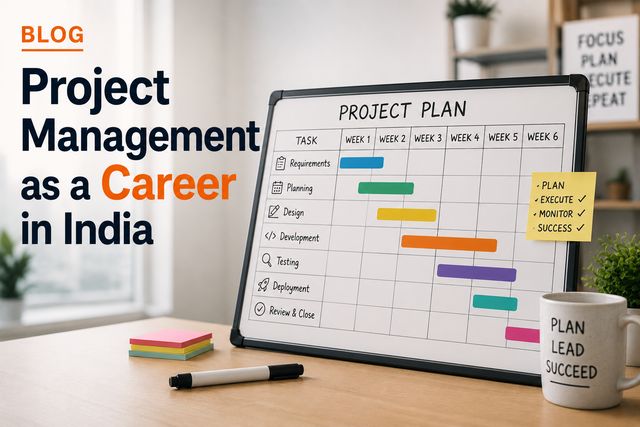
A project management career in India is a strong, accessible option in 2026, especially for organised people and career-switchers who do not want to code. Project managers plan work, coordinate teams, manage timelines and risk, and make sure things actually ship. Demand exists across almost every industry, and the path in is open to people from many backgrounds.
What a project manager actually does
The job is often misunderstood. A project manager does not sit above a team giving orders. The real work is removing obstacles so the team can do its best work and keeping everyone aligned on what matters.
On a typical week, a project manager:
- Breaks a goal into a clear scope and plan.
- Tracks progress against timelines and budgets.
- Spots risks early and works to reduce them.
- Keeps stakeholders informed and expectations realistic.
- Unblocks the team and resolves conflicts.
It is a people-and-systems role more than a technical one. The best project managers are calm, organised and good communicators. If that sounds like you, the Project Management course is built to turn those traits into job-ready skills.
Why it suits career-switchers
Project management is one of the friendliest tech-adjacent careers for people coming from other fields, and that is not a coincidence. Many of the core skills, organisation, communication, follow-through, are built in other jobs and other lives.
People move into it from operations, customer support, teaching, sales, even unrelated fields, because what they already do well transfers directly. You are not starting from zero. You are repackaging skills you have into the language and tools of project delivery.
Where project managers work
Demand is broad, which is part of the appeal. You are not tied to one industry.
| Sector | What PMs do there |
|---|---|
| IT and software | Run product and software delivery projects |
| Construction and real estate | Coordinate sites, vendors and timelines |
| Consulting | Manage client engagements and deliverables |
| Banking and finance | Drive process and technology change |
| Startups | Wear several hats, keep delivery on track |
This breadth means your skills stay relevant even if you change industries. Few careers offer that kind of portability.
Project manager vs product manager
People often confuse the two. A quick distinction: a project manager is responsible for delivering a defined piece of work on time and on budget. A product manager is responsible for deciding what to build and why, based on users and the business.
They overlap, and in smaller companies one person may do both, but the mindsets differ. If you lean toward deciding what gets built rather than ensuring it ships, our guide on how to become a product manager in India covers that path.
Indicative salary in 2026
As indicative 2026 estimates based on common India ranges, project management pay looks roughly like this:
| Level | Typical role | Indicative range |
|---|---|---|
| Entry | Associate / junior PM | 5 to 9 LPA |
| Mid | Project manager | 9 to 18 LPA |
| Senior | Senior PM / programme manager | 18 LPA and above |
These are planning estimates, not promises. Pay varies a lot by industry, city and company size. IT, consulting and finance tend toward the higher end, and metro cities including the Mumbai region pay more than smaller centres.
How to start with no experience
You do not need to wait for a title to begin building the skill. A practical sequence:
- Learn the fundamentals: scope, schedule, budget, risk, stakeholder management.
- Understand common ways of working, such as Agile and Scrum.
- Learn the tools teams use, like Jira and a planning board.
- Take on coordination work in your current role to build real examples.
- Build a small portfolio of projects you helped plan or deliver.
Real practice matters more than certificates alone. Employers want to see that you can actually run a project, not just name the phases. That is why our course is project-based: you learn by managing real work with guidance. If you are still weighing this against other courses, our overview of the best software courses with placement in Navi Mumbai puts the options side by side.
The honest part
A few honest points so you go in clear-eyed. Project management carries real responsibility and pressure, because when things slip, you are accountable for getting them back on track. It is also a role you grow into over time; your first projects will be smaller, and judgement builds with experience. And while it does not require coding, basic technical literacy genuinely helps when you work with engineering teams.
None of this should put you off. It simply means the role rewards people who are steady, organised and willing to keep learning.
The honest takeaway
Project management is a durable, portable and accessible career in India, well suited to organised communicators and career-switchers who would rather coordinate than code. The path in is open if you build the fundamentals and get real practice.
If you want a structured route with project-based learning, mentors who manage real delivery, and placement support through our hiring partners, the Project Management course at The Contrast Academy in Navi Mumbai is designed for exactly that. Treat the salary figures here as planning estimates and focus on building the skills behind them.
FAQ
Quick answers.
Is project management a good career in India in 2026?
Yes. Almost every company runs projects, so demand is broad across IT, construction, consulting and more. It suits people who are organised, communicate well and like getting things done through others. It is also one of the more accessible tech-adjacent careers for non-coders.
Do I need to know coding to be a project manager?
No. Project managers coordinate people, scope, timelines and risk rather than write code. Basic technical literacy helps you communicate with developers, but you do not need to be a programmer.
What is the salary of a project manager in India?
As an indicative estimate, associate or junior project managers earn roughly 5 to 9 LPA, mid-level PMs around 9 to 18 LPA, and senior PMs or programme managers 18 LPA and above. Figures vary by industry, city and company.
How do I start a project management career with no experience?
Start by learning the fundamentals of scope, schedule, budget and stakeholder management, then take on coordination responsibilities in your current role or through a project-based course. A structured course plus real practice is the most reliable route.