Guides
How to Build an MVP: A Step-by-Step Guide for Founders
31 May 2026 · 8 min read · The Contrast
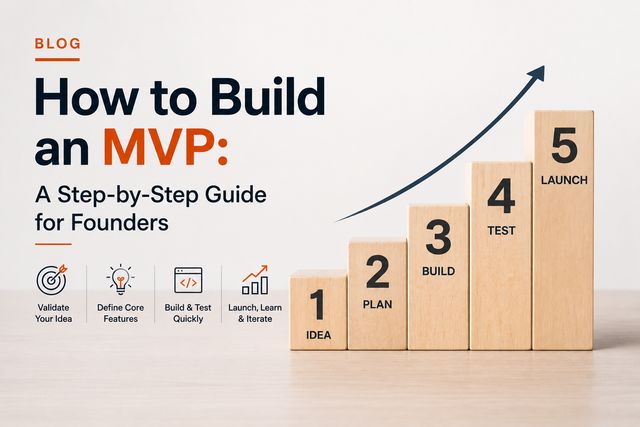
To build an MVP, define one core problem, cut your idea down to the smallest version that tests it, pick a small senior team, and ship in 6 to 12 weeks. Then you learn from real users and decide what to build next. The hard part is not the code. It is the discipline to build less. Here is the step-by-step.
Step 1: Name the one problem you are solving
An MVP is the smallest version of your product that tests whether people want it. Before any design or code, write down the single problem you are solving and the one assumption you most need to prove. If you cannot say it in a sentence, you are not ready to build.
This sentence becomes your filter for every later decision. When a feature comes up, you ask whether it helps test that assumption. If it does not, it waits. Most failed MVPs fail here, not in engineering. They try to solve five problems at once and prove none of them.
Step 2: Validate before you build
Building is the expensive way to learn something you could have learned for free. Before you commit a budget, talk to the people who have the problem, watch how they solve it today, and confirm they would pay for a better way.
We cover the full process in how to validate a startup idea before you build, but the short version is: if you cannot find ten people who clearly want this, more code will not help. Validation does not replace the MVP. It tells you the MVP is worth building.
Step 3: Cut scope until it hurts
This is where founders lose the most money. Your MVP should do one thing well, not ten things adequately. List every feature you imagine, then split the list into two columns: needed to test the core assumption, and everything else. The second column is your version two.
A practical way to cut:
- Pick one platform. Launch web or mobile, not both, unless the idea genuinely needs both from day one.
- Pick one user type. Each extra role adds screens, permissions and testing.
- Use proven services. Use existing tools for payments, auth and hosting instead of building them.
- Skip the admin panel. You can manage early data by hand while you have few users.
The goal is to learn fast and cheap. A smaller MVP ships sooner, costs less, and gives you real answers earlier. You can model the budget for different scopes in how much it costs to build an MVP in 2026.
Step 4: Choose a tech stack you will not regret
Pick boring, proven technology that your team knows well and that you can hire for later. A new MVP is not the place to experiment with a trendy framework. The right stack depends on your product, your timeline and who is building it. We walk through the trade-offs in how to choose the right tech stack for your startup.
The decision matters less than founders fear at the MVP stage, as long as the choice is mainstream and maintainable. What hurts later is an exotic stack that no one else can pick up.
Step 5: Design the core flow, not the whole app
Design only the screens a user must pass through to experience the core value. Map the main path from first open to the moment the product delivers on its promise. That path needs to be clean and clear. Settings screens, edge cases and secondary flows can be rough or skipped for now.
A considered, simple interface does more for an early product than a sprawling one. Fewer screens also mean fewer things to build, test and explain.
Step 6: Build with a small senior team
An MVP is mostly labour, so who builds it decides both the cost and the quality. A small senior team writes less code to solve the same problem, makes fewer expensive mistakes, and moves faster than a large junior one. Avoid hand-offs: every account manager or middle layer between you and the engineers is money and time lost in translation.
This is how we run MVP development. A two or three person senior team, billed weekly, with you talking directly to the people writing the code. A senior engineer with us starts at about $20 an hour, which keeps a real MVP in reach for most founders. You can see the structure on our MVP development service page.
Step 7: Ship, measure, and decide
Launch to real users as soon as the core flow works. The MVP exists to produce evidence, so watch what people actually do, not what they say they will do. Track whether they complete the core action, come back, and tell others.
Then decide honestly. Sometimes the data says build more. Sometimes it says change direction. Sometimes it says stop. All three are wins, because each one saved you from spending years on the wrong thing.
The mindset that makes MVPs work
The founders who succeed treat the MVP as a question, not a finished product. They build the smallest thing that can answer the question, ship it quickly, and stay willing to be wrong. The ones who struggle treat the MVP as version one of their grand vision and try to build all of it at once.
Build less, ship sooner, learn faster. If you want a senior team that works this way and quotes the price up front, that is exactly what our MVP development approach is built for.
See our MVP development service →
FAQ
Quick answers.
What is the first step to building an MVP?
Write down the single problem you are solving and the one assumption you most need to test. Everything else in the build follows from that. If you cannot state it in a sentence, the scope is not clear enough to start.
How long does it take to build an MVP?
A focused MVP usually takes 6 to 12 weeks with a small senior team. If your plan runs much longer than that, the scope is probably too large to be a true MVP and should be cut down.
Do I need to know how to code to build an MVP?
No. Plenty of founders are non-technical. What you do need is a clear problem, a willingness to cut scope, and a senior team you can talk to directly without layers in between.
Should I build the MVP myself or hire a team?
If you can build it well and quickly yourself, do that. Most founders cannot, and a small senior team ships faster and cleaner than a first-time build, often for less than a year of trial and error.