Guides
How to Choose the Right Tech Stack for Your Startup
29 May 2026 · 8 min read · The Contrast
To choose the right tech stack for your startup, pick proven, mainstream tools that your team knows well and that you can hire for later, then match the choice to your product type and timeline. The best early stack is usually the boring, popular one. It is well documented, widely supported, and easy to staff. Here is how to decide without overthinking it.
What a tech stack actually is
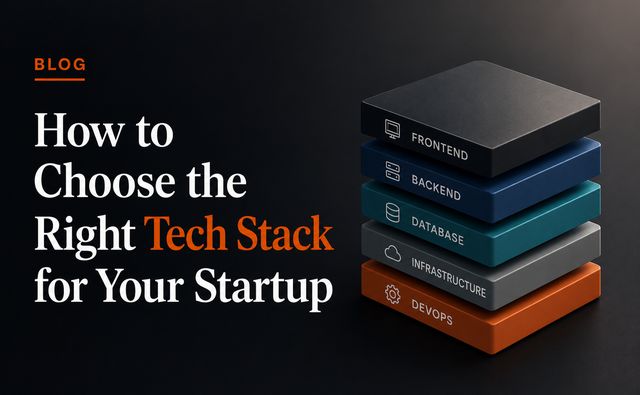
Your tech stack is the set of languages, frameworks, databases and services your product is built on. It usually breaks into a front end (what users see), a back end (the logic and data), a database, and the hosting and tools around them. You do not need to master each layer, but you should understand the choices being made on your behalf.
The stack matters because it shapes how fast you can build, how easily you can hire, and how much the product costs to run and maintain. A good choice is invisible. A bad one shows up later as slow features, hard-to-find developers and expensive rewrites.
Principle 1: Boring and proven beats new and exciting
The single most useful rule is to choose mainstream, mature technology. Popular stacks have large communities, plenty of libraries, strong documentation and a deep pool of developers who already know them. New frameworks promise elegance but come with fewer tools, smaller talent pools and more rough edges you will hit at the worst time.
A startup's job is to test an idea, not to push the boundaries of technology. Save the experiments for the one or two places where your product genuinely needs them. Everything else should be the safe, well-trodden path.
Principle 2: Match the stack to your product
Different products lean toward different choices. A few rough guides:
- Content-heavy or marketing-led web app. A standard server-rendered or modern JavaScript framework with a relational database covers most needs.
- Real-time features (chat, live updates). You will want a back end and database that handle live data well, which narrows the sensible options.
- Mobile-first product. The stack question is tied to whether you go native or cross-platform, which affects timeline too. We cover that in how long it takes to build an app.
- Data or AI-heavy product. The language and infrastructure around your data pipeline matter more than the front-end framework.
Start from what the product needs to do, not from a stack you read about. The product decides the tools, not the other way around.
Principle 3: Choose what your team knows
A stack is only as good as the people using it. A team that is fluent in a slightly less fashionable technology will out-ship a team learning a trendy one on the job. Familiarity means fewer mistakes, faster delivery and code that someone can actually maintain later.
This is one reason to build with senior people. They have made the stack decisions before, know where each option breaks, and write less code to achieve the same result. It is also why we are upfront about the stacks we work in for web app development, so you know exactly who is building on what.
Principle 4: Plan for hiring and handover
At some point, someone other than your first team will touch the code. If your stack is mainstream, finding that person is straightforward and affordable. If it is exotic, you may be stuck with a tiny, expensive talent pool, or a rewrite.
Before committing, ask a simple question: in two years, how easy will it be to hire someone who knows this well? If the honest answer is "hard," reconsider. A popular stack is an asset every time you grow the team.
Principle 5: Do not over-engineer for scale you do not have
Founders often pick complex, scalable architectures for traffic they may never see. This is a costly trap. Premature scaling adds complexity, slows down building, and raises both build and hosting costs while you are still trying to find product-market fit.
Build for the scale you have plus a reasonable margin. Proven stacks handle far more load than most early startups ever reach. When you genuinely outgrow the first design, you will have the revenue and knowledge to make better scaling decisions. Tie this to your roadmap the way you would when building an MVP step by step: solve today's problem well, leave tomorrow's for tomorrow.
A simple decision checklist
When you or your team are weighing a stack, run it through these questions:
- Is it mainstream and actively maintained?
- Does my team already know it well?
- Can I hire for it easily and affordably later?
- Does it fit what this specific product needs to do?
- Is it the simplest option that meets the need?
If you can answer yes to most of these, you have a sound choice. If you are saying no to several, the stack is probably being chosen for the wrong reasons.
Getting the decision right with the right team
The stack matters, but who builds with it matters more. A senior team makes these choices quickly and correctly because they have lived with the consequences of each one. They will steer you toward the boring, reliable option and reserve complexity for where it earns its keep.
That is how we approach web app development: proven stacks, senior engineers, and no jargon between you and the people writing the code. If you are unsure which stack fits your product, a real person will talk it through with you in a 15-minute call before you commit to anything.
See our web app development service →
FAQ
Quick answers.
How do I choose a tech stack for my startup?
Pick mainstream, well-supported tools that your team knows well and that you can hire for later. Match the stack to your product type and timeline, and avoid trendy choices that few people can maintain. The safe, popular option is usually the right one early on.
Does the tech stack really matter for an MVP?
Less than founders fear, as long as the choice is proven and maintainable. At the MVP stage, shipping speed and the team's familiarity matter far more than picking a theoretically perfect stack. The stack hurts you only when it is exotic.
Should I use the newest framework available?
Usually not. New frameworks have fewer libraries, smaller talent pools and more rough edges. For a startup, boring and proven beats new and exciting. Save the experiments for problems your product genuinely cannot solve any other way.
Can I change my tech stack later?
Yes, but it is costly. Parts can be replaced over time, and a full rewrite is sometimes worth it once you have scale and revenue. The goal early on is a stack that will not force a rewrite before you have learned whether the product works.