Careers
How to Crack Your First Developer Interview
17 May 2026 · 7 min read · The Contrast
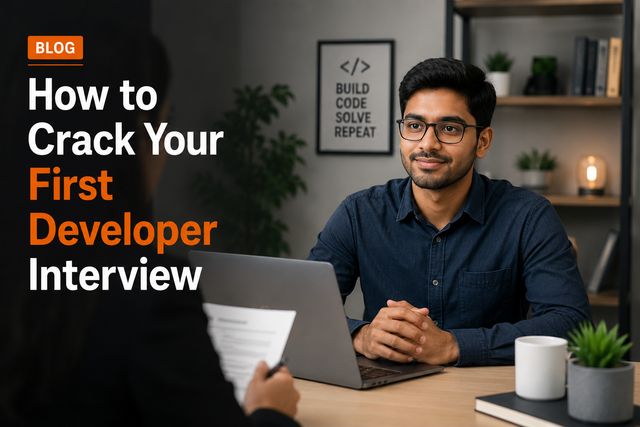
The most useful first developer interview tips are simple: know your own projects deeply, practice explaining your thinking out loud, and revise the fundamentals calmly. Most freshers fail not from lack of skill but from nerves and poor preparation. Here is an honest plan that works.
What a first interview actually tests
Companies hiring freshers know you have little experience. They are not expecting a senior engineer. They are checking three things:
- Can you build? Usually tested through your projects and a coding problem.
- Can you think? Tested by how you approach a problem you have not seen before.
- Can you work with people? Tested through behavioural questions and how you communicate.
Once you understand this, preparation becomes less about memorising and more about being ready to demonstrate these three things.
Start with your own projects
This is the part most people underprepare, and it is the easiest to control. You will be asked, in detail, about the projects on your resume. If you cannot explain your own work, nothing else matters.
For each project, be ready to answer:
- What problem does it solve?
- Why did you choose this stack and structure?
- What was the hardest part, and how did you solve it?
- What would you do differently now?
This is exactly why we push learners toward portfolio projects that actually get you hired rather than copied tutorials. If you built it yourself and made real decisions, these questions become easy.
Revise the fundamentals, calmly
You do not need to grind hundreds of problems. You need solid fundamentals.
| Area | What to cover |
|---|---|
| Language basics | Core syntax, data types, common methods of your main language |
| Data structures | Arrays, objects, maps, and when to use each |
| Problem solving | Easy to medium problems; focus on approach, not tricks |
| Framework basics | The core concepts of the framework you use |
| Web fundamentals | How a request flows from browser to server to database |
Spread this over a few weeks. Steady revision beats a panicked all-nighter, which usually leaves you tired and anxious on the day.
Practice thinking out loud
Here is something many freshers do not realise: in a coding interview, the interviewer often cares more about how you think than whether you reach the perfect answer. A candidate who talks through their approach, considers options, and reasons clearly will often beat one who silently produces a correct answer.
So practice this deliberately. When you solve a problem, narrate it: "I am going to start by understanding the input, then I will try a simple approach, then improve it." Do this until it feels natural. It is a skill, and it is learnable.
Behavioural questions matter more than you think
You will be asked things like "Tell me about a time you were stuck" or "How do you handle feedback." These are not filler. Companies want people who can work in a team, take code reviews well, and stay calm under pressure. Have two or three short, honest stories ready from your projects or studies. Keep them real; rehearsed-sounding answers work against you.
It is okay to say "I do not know"
When you hit a question you cannot answer, do not bluff. Interviewers can tell. The strong move is to say, "I am not sure, but here is how I would find out," and then reason it through. This shows honesty and problem-solving at the same time, which is exactly what they are looking for. Admitting a gap with a clear thought process builds more trust than a confident wrong answer.
A simple preparation timeline
- Three to four weeks before: Revise fundamentals a little each day. List your projects and write out answers for each.
- Two weeks before: Do timed practice problems, thinking out loud each time.
- One week before: Do mock interviews with a friend or mentor. Get feedback.
- The day before: Rest. Re-read your project notes. Do not cram.
- On the day: Arrive calm, listen carefully, and ask clarifying questions before you start coding.
Where mentorship helps
Mock interviews with someone who hires for a living are worth more than any amount of solo practice, because they tell you what you actually sound like. At the academy, interview preparation, communication practice, and mock interviews are part of the curriculum, not an afterthought. Combined with placement support through 50+ hiring partners, this is how we have helped train and place 100+ people since 2015. If you want this kind of structured preparation, our Full-Stack course builds it in, and the 2026 full-stack roadmap shows where interview prep fits in the wider journey. When you do land the role, knowing the realistic full-stack salary ranges in India will help you negotiate with confidence. For a path that combines all of this, see our Full-Stack course.
FAQ
Quick answers.
How do I prepare for my first developer interview?
Start with your own projects, because you will be asked about them in depth. Then revise core fundamentals, practice explaining your thinking out loud, and do a few mock interviews. Preparation should be steady over a few weeks, not a panic the night before.
What questions are asked in a fresher developer interview?
Expect questions about your projects, basic coding problems, fundamentals of your language and framework, and a few behavioural questions about how you work in a team. Many interviews care more about how you think than whether you reach the perfect answer.
Is it okay to say I do not know in an interview?
Yes. Admitting you do not know something, then explaining how you would find out, is far better than bluffing. Interviewers can tell when someone is guessing, and honesty with a clear thought process builds trust.
How important is communication in a developer interview?
Very. Two candidates with the same skill often get different outcomes purely based on how clearly they explain their reasoning. Talking through your approach as you solve a problem is a skill worth practising before the interview.