Guides
How to Take Over a Stalled Software Project Without Starting Over
23 Jul 2026 · 7 min read · The Contrast
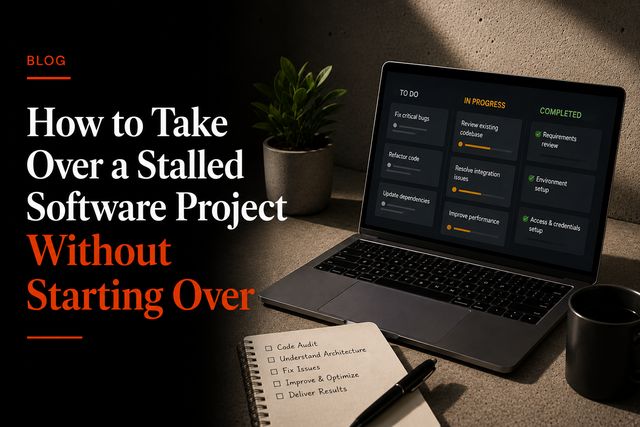
A stalled software project rarely needs to be thrown away. In most cases a new team can pick up what exists, keep the parts that are sound, and finish the build for far less than starting over. The key is an honest audit before anyone quotes a price — so you know what you actually have before you spend another rupee or dollar. Here's how a proper takeover works.
First, get your access in order
Before a new team can help, you need to control your own project. That means:
- Your code repository — GitHub, GitLab or Bitbucket, in an account you own.
- Your cloud and hosting accounts — the servers, database and services the app runs on.
- Any designs, requirements or documentation the previous team produced.
If the previous developer holds these and won't hand them over, sorting that out is step one. It's also the clearest red flag from the original engagement: a team that keeps your code and accounts in their own name was never really building it for you. On a healthy project, all of this lives in your name from the first commit.
The audit: what's actually there
A takeover starts with reading the code, not rewriting it. A good team spends a few days answering four questions honestly:
| Question | Why it matters |
|---|---|
| Is the code readable and structured? | Decides whether it can be extended or has to be replaced |
| Does it do what the previous team claimed? | Demos and reality often differ |
| Is it safe — data, access, dependencies? | Unsafe foundations cost more the longer they run |
| How much is genuinely reusable? | This is the number that drives the whole decision |
The output is a plain-English assessment: here's what works, here's what doesn't, here's what we'd keep and what we'd replace. No jargon wall, no pressure — just the honest state of your build. This is the same discipline you'd want when vetting any development agency: make them show their reasoning.
Continue or rebuild? The honest test
The instinct of many teams is to declare everything worthless and pitch a full rebuild — it's more billable. That's not honest, and it's often wrong. The real test is simple:
- Continue when the foundation is sound and most of the work is reusable. You keep the momentum and the money already spent.
- Rebuild the weak parts when specific pieces are unsafe or unmaintainable, but the rest holds.
- Start over only when continuing would cost more over the next year than a fresh, targeted build — and a good team can show you the math.
Most stalled projects land in the first two rows. A full teardown is the exception, not the default.
What a good takeover looks like
- Access secured — everything in your accounts, in your name.
- Audit delivered — a written, honest read on what you have, in days.
- Completion quoted in writing — a real price and timeline for finishing, built from a published rate rather than a mystery number.
- Build resumes in milestones — weekly demos, each approved before the next, so you rebuild trust as fast as you rebuild the product.
The reassuring part
If your build has stalled, gone quiet, or the last team disappeared, you're probably closer to the finish line than it feels. The work already done is usually worth something, and the fix is rarely to start from zero. What you need is a team that will read what exists and tell you the truth about it — then quote the rest in writing.
That's exactly what a free build assessment is: we audit what you have, tell you honestly what's salvageable, and give you a written price to finish it. No obligation, and no pretending everything must be rebuilt.
FAQ
Quick answers.
Can a new team take over a half-finished software project?
Almost always, yes. A stalled project rarely needs to be scrapped. A good team audits the existing code, tells you honestly what's salvageable and what isn't, and quotes the completion in writing before touching anything.
Should I rebuild from scratch or continue the existing code?
It depends on the state of the code, and an honest team will tell you straight. Sometimes 70% is reusable and continuing is far cheaper. Sometimes the foundation is unsafe and a targeted rebuild costs less over the next year. The answer comes from an audit, not a sales pitch.
What do I need to hand over to a new developer?
Access to your code repository, any cloud or hosting accounts, the original requirements or designs if they exist, and whatever the previous team documented. If you don't have repository access, getting it is the first thing to sort out.
How long does it take to take over a stalled project?
The audit itself is usually days, not weeks. After that, the completion timeline depends on how much is salvageable and what's left to build — which is exactly what the audit is there to tell you.