Comparison
Native vs Cross-Platform App Development in 2026
4 Jun 2026 · 8 min read · The Contrast
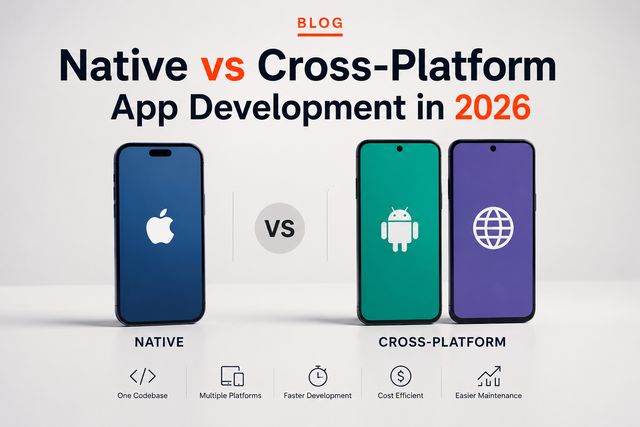
For most products in 2026, cross-platform app development is the right starting point: one codebase covers iOS and Android, which is cheaper and faster to build and maintain. Native development suits performance-heavy apps, deep hardware use or pixel-perfect platform design. Both approaches ship excellent apps, so the choice is about fit and budget. Here is the honest comparison.
Native vs cross-platform at a glance
The decision usually comes down to cost, performance, time to market, and how much you lean on platform-specific features. This table is a practical summary for founders.
| Factor | Native (Kotlin/Swift) | Cross-platform (Flutter/React Native) |
|---|---|---|
| Codebases | Two (iOS + Android) | One, shared |
| Relative cost | Higher | Lower (often 30–40% less) |
| Time to market | Slower | Faster |
| Performance | Maximum | Excellent for most apps |
| Best for | Games, AR, heavy hardware use | Most products and MVPs |
Neither approach is wrong. The table tells you which trade-off you are making. The framework logic mirrors the web, where the same "fit over fashion" rule applies, covered in React vs Angular vs Vue.
Cross-platform: the default for most products
Cross-platform frameworks like Flutter and React Native let you write one codebase that runs on both iOS and Android. That single codebase is the whole point: you build once, maintain once, and ship to both stores at the same time. For most products, that means lower cost and faster time to market, often cutting build and maintenance by a meaningful margin against two native apps.
The performance gap that once justified native has narrowed sharply. For the vast majority of apps, dashboards, marketplaces, social products, booking and SaaS apps, cross-platform performance is indistinguishable from native to the user. The frameworks have matured to the point where most users could not tell you which approach built the app on their phone.
Cross-platform also keeps your future cheaper. Every new feature, bug fix and OS update is done once, not twice, so the savings compound over the life of the product rather than landing only at launch. Our mobile app development work is mostly cross-platform for exactly this reason: founders get both platforms for close to the price of one, and pay less to keep them running.
Native: when performance and hardware lead
Native development means building separately for each platform, Kotlin for Android and Swift for iOS, using each platform's own tools. You maintain two codebases, which costs more and takes longer, but you get maximum performance and the deepest access to device hardware and platform features.
Native is the right call for performance-critical apps: games, augmented reality, apps with heavy real-time processing, intensive camera or sensor use, or designs that must be pixel-perfect to each platform's conventions. If your product's core value depends on squeezing the most out of the device, native earns its premium. We offer dedicated native app development for exactly these cases.
Cost and time: the real difference
For most founders, the deciding factor is cost and time, not a benchmark. With cross-platform you build and maintain one codebase; with native you build and maintain two. That is why cross-platform typically lands 30 to 40 percent cheaper over the life of the product, and ships faster.
That said, "cheaper" is not the same as "right". If you build cross-platform when your product genuinely needs native performance, you pay later in rework. The honest order is: define what the product needs, then pick the approach. For how either choice turns into a budget, see our cost to build a mobile app guide, and for the wider product budget, our cost to build an MVP guide.
How to choose
Match the approach to what your product actually needs:
- Choose cross-platform for most products, MVPs, and anything where time to market and budget matter and performance needs are normal.
- Choose native for games, AR, heavy hardware use, real-time processing, or pixel-perfect platform design.
- Start cross-platform, go native later for the performance-critical parts only, if and when you prove you need them.
The approach matters less than the team. Senior mobile engineers will ship a fast, clean app either way; a weak team will struggle with both.
How we approach it
We recommend the approach that fits your product, not the one with the bigger invoice. For most founders that means cross-platform, so you get iOS and Android for close to the price of one, and we are honest when native is the better call. Either way you get senior engineers and a single owning team from architecture through launch.
Our mobile app development service covers the full build with people you talk to directly, not an account manager, and pricing on the page from about $20/hour. We have run this model since 2015 across more than 320,000 project hours.
FAQ
Quick answers.
Native or cross-platform app development in 2026?
Cross-platform fits most products: one codebase covers iOS and Android, which is cheaper and faster. Native suits performance-heavy apps, deep hardware use or platform-specific design. For most founders, cross-platform is the right starting point.
Is cross-platform cheaper than native?
Usually yes. One shared codebase instead of two separate apps typically cuts build and maintenance cost by a meaningful margin, often 30–40 percent, because you are not building and maintaining iOS and Android twice.
When should I build a native app?
Build native when you need maximum performance, heavy use of device hardware, complex animations, or pixel-perfect platform-specific design, such as games, AR, or apps with intensive real-time processing.
Which is better, Flutter or React Native?
Both are strong cross-platform choices in 2026. React Native suits teams already in the React ecosystem; Flutter gives very consistent UI across platforms. The right one depends on your team and product, not a universal winner.