Comparison
React vs Angular vs Vue for Your Product (2026)
5 Jun 2026 · 8 min read · The Contrast
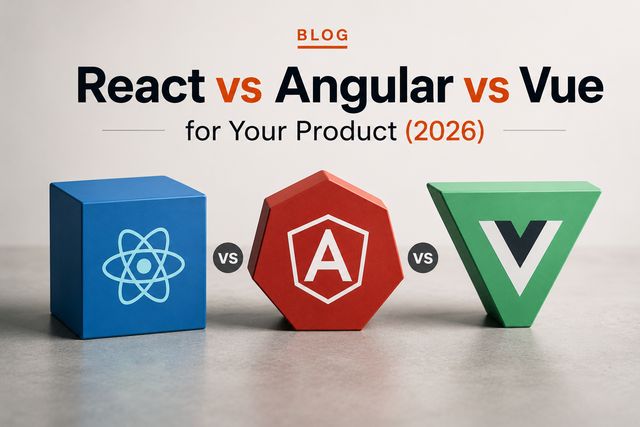
For most products in 2026, React is the safe default: it fits the widest range of apps and is the easiest to hire for. Angular suits large enterprise applications that benefit from strong built-in conventions, and Vue suits lean teams that want a gentle learning curve. All three are mature and production-ready, so the choice is about fit and hiring, not quality. Here is the honest comparison.
React vs Angular vs Vue at a glance
The decision usually comes down to learning curve, talent availability, structure, and the kind of app you are building. This table is a practical summary for founders, not a benchmark.
| Factor | React | Angular | Vue |
|---|---|---|---|
| Best for | Most products, fast hiring | Large enterprise apps | Lean teams, gentle ramp |
| Learning curve | Moderate | Steep | Gentle |
| Talent pool | Largest | Large | Smaller |
| Structure | Flexible (you choose) | Opinionated (built in) | Flexible, guided |
| Type of app | SPAs, dashboards, most web apps | Big, long-lived systems | Content sites, mid-size apps |
None of these is a wrong choice. The table tells you which trade-off you are making. The framework is one piece of a wider decision we cover in choosing the right tech stack.
React: the safe default
React is the default for most products because of its ecosystem and talent pool. There are more React developers than for any other front-end framework, which makes hiring faster, scaling easier and maintenance cheaper over the life of the product. The library itself is flexible: you assemble routing, state and tooling to fit your needs.
That flexibility is also React's main cost. Because it does not impose structure, a weak team can build an inconsistent codebase. The fix is senior engineers who set conventions early. For most founders building dashboards, SaaS apps or customer portals, React is the lowest-risk choice. Our web app development work is mostly React for exactly these reasons.
Angular: built for large enterprise apps
Angular is a full framework rather than a library. Routing, forms, HTTP and state management come built in, with strong conventions and tooling out of the box. For large, long-lived enterprise applications worked on by big teams, that structure is a genuine advantage: it keeps everyone consistent and reduces the bikeshedding that flexible stacks invite.
The trade-off is a steeper learning curve and more ceremony. For a small product or an MVP, Angular can feel heavy, and the talent pool, while large, is smaller than React's. Choose Angular when you are building a big system that will live for years and be maintained by a sizable team.
Vue: lean and approachable
Vue sits between the two. It is approachable, with a gentle learning curve and clear documentation, and it gives you guided structure without Angular's weight. Lean teams often move fast in Vue, and it is well suited to content-driven sites and mid-size applications.
Vue's main drawback is a smaller talent pool, especially for senior engineers, which can make hiring and scaling harder in some markets. If your team already knows Vue or values its developer experience, it is an excellent choice. If you expect to scale a large team quickly, React's depth is safer.
How to choose
Match the framework to your product and your hiring plan:
- Choose React for most products, especially if you want the easiest hiring and a large ecosystem.
- Choose Angular for large enterprise applications where built-in structure keeps big teams consistent.
- Choose Vue for lean teams, content-driven sites and mid-size apps where developer experience matters.
The framework rarely makes or breaks a product. Senior engineers, clear architecture and a stack your team can hire for matter far more. The same logic applies on mobile, where the build-time choice is platform rather than framework, covered in native vs cross-platform app development. And the cost of the framework choice mostly shows up later, in hiring and maintenance rather than the initial build, which we break down in our cost to build an MVP guide.
How we approach it
We pick the stack that fits your product, your timeline and your hiring plan, not the one that is fashionable. For most builds that means React, but we are honest when Angular or Vue is the better fit. Either way, you get senior engineers who set conventions early, so the codebase stays clean as it grows.
We deliver this end to end. Our web app development service covers architecture, build, testing and launch with a single owning team, and you can see the full range across our services. You talk to the engineers building your product, not an account manager, with pricing on the page from about $20/hour. We have run this model since 2015 across more than 320,000 project hours.
FAQ
Quick answers.
React, Angular or Vue in 2026?
React fits most products and is easiest to hire for, Angular suits large enterprise applications that benefit from strong conventions, and Vue suits lean teams that want a gentle learning curve. For most founders, React is the safe default.
Which is easiest to hire developers for?
React, by a wide margin. It has the largest talent pool and ecosystem, so finding and scaling a team is faster and usually cheaper than for Angular or Vue.
Is Angular still a good choice in 2026?
Yes, for large, long-lived enterprise applications where its built-in structure, tooling and conventions keep big teams consistent. For small products it can feel heavy.
Does the framework choice affect cost?
Indirectly. The framework rarely changes the build cost much, but a larger talent pool like React's makes hiring and maintenance cheaper over the life of the product.