Guides
What is an MVP in Software Development? A Complete Guide for Startups in 2026
7 Aug 2026 · 9 min read · By Prarthana Warrier
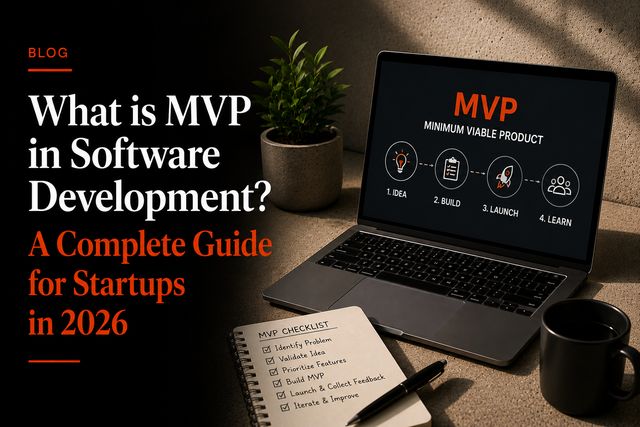
Every successful digital product starts with an idea. The challenge isn't coming up with that idea — it's validating whether people actually want it before investing significant time and money into building it. This is where the Minimum Viable Product (MVP) approach comes in.
If you've searched "What is MVP in software development?", "MVP meaning", or "How to build an MVP", you're asking the same question thousands of founders, product managers and software developers ask every month. In this guide we'll explain what an MVP is, why it's important, how to build one, common mistakes to avoid, and how startups can validate ideas while reducing development costs.
What is an MVP in software development?
An MVP (Minimum Viable Product) is the simplest version of a software product that includes only the essential features needed to solve a core user problem and collect real-world feedback.
Instead of spending months — or even years — building every feature you imagine, an MVP lets you launch quickly, validate assumptions and improve the product based on actual user behaviour. The goal of MVP development isn't to create an incomplete product. It's to build the right product with the minimum required functionality.
Example
Imagine you're building a food delivery app. A typical MVP would include:
- User registration
- Restaurant listings
- Search functionality
- Order placement
- Basic online payment
Features like loyalty rewards, AI recommendations, live order tracking or subscriptions can be introduced after validating user demand.
Why is an MVP important?
Many startups fail not because they can't build software, but because they build products that customers don't need. An MVP reduces this risk by letting founders test assumptions before making large investments. Key benefits include:
- Faster time-to-market
- Lower software development costs
- Early customer feedback
- Product validation
- Better investor confidence
- Reduced business risk
- Easier prioritisation of future features
Rather than guessing what users want, you learn directly from real users.
Benefits of MVP development
1. Validate your startup idea
Before investing heavily, you need evidence that your solution solves a genuine problem. An MVP helps validate customer demand, pricing strategy, market opportunity, user behaviour and product-market fit. If you're still evaluating your concept, read our guide on how to validate a startup idea.
2. Reduce development costs
Building a complete product with every planned feature can be expensive. Launching with core functionality lets startups avoid unnecessary development, focus on high-impact features, improve budgeting and reduce rework. If you're planning your budget, check our detailed guide on the cost to build an MVP in 2026.
3. Faster product launch
Launching early gives you valuable insights months before competitors who wait for a "perfect" product. Early users provide feedback, feature requests, bug reports, usage data and testimonials — all of which guide future development with confidence.
4. Better product decisions
Every feature added after launch is backed by user feedback instead of assumptions. This creates a more customer-centric product.
How to build an MVP
Building an MVP is a structured process — not simply removing features.
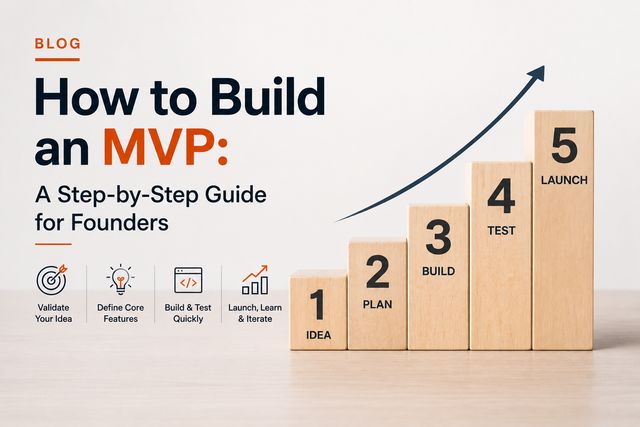
Step 1: Identify the problem
Start by defining the specific problem you're solving. Ask: Who is the customer? What challenge do they face? Why hasn't it been solved effectively?
Step 2: Validate the idea
Talk to potential users. Conduct interviews. Create surveys. Research competitors. Understand customer pain points before writing code.
Step 3: Prioritise core features
Focus only on features necessary to solve the primary problem. A useful framework is the MoSCoW method:
- Must Have
- Should Have
- Could Have
- Won't Have (for now)
Step 4: Design the user experience
Create user flows, wireframes and interactive prototypes. Good design reduces development changes later.
Step 5: Develop the MVP
Use Agile development practices to build core functionality, secure authentication, a basic dashboard and essential workflows. Skip advanced features until validation.
Step 6: Launch and measure
Track user acquisition, retention, engagement, customer feedback, feature usage and churn rate. Your MVP is only successful if you learn from the data.
For a detailed walkthrough, read our complete guide on how to build an MVP step by step.
MVP vs prototype
| MVP | Prototype |
|---|---|
| Working product | Concept demonstration |
| Used by real users | Used internally or for stakeholder feedback |
| Collects customer feedback | Validates design ideas |
| Includes essential functionality | May not have working functionality |
A prototype answers: Can we build this? An MVP answers: Should we build this?
MVP vs proof of concept (PoC)
| Proof of Concept | MVP |
|---|---|
| Tests technical feasibility | Tests market demand |
| Internal validation | Customer validation |
| Usually not customer-facing | Used by real customers |
| Short experiment | First usable product |
Real-world MVP examples
Airbnb
The founders started by renting out space in their own apartment during a conference. They didn't build a complex booking platform first — they validated demand.
Dropbox
Before building the product, Dropbox released a simple explainer video. The response validated strong customer interest.
Instagram originally focused on one primary capability: photo sharing. Additional features such as Stories and Reels came much later.
Uber
Uber's first version connected riders with drivers in a single city. Expansion came after proving the concept.
Common MVP mistakes
Building too many features
Adding unnecessary functionality delays launch and increases costs.
Ignoring customer feedback
An MVP without feedback is simply an early product release. Listen to users. Improve continuously.
Choosing the wrong audience
Your first users should represent your ideal customers. Testing with the wrong audience can produce misleading conclusions.
Waiting for perfection
Perfection delays learning. An MVP should be usable, reliable and focused — not feature-complete.
How much does MVP development cost?
The cost depends on factors such as the number of features, platform (web, mobile, SaaS), UI/UX complexity, integrations, team size and development timeline. A simple MVP is typically much more affordable than a full-featured product because it focuses only on essential functionality.
For a detailed breakdown of pricing factors, timelines and cost estimates, read our guide on the cost to build an MVP in 2026.
Can AI accelerate MVP development?
AI-assisted development is helping teams move faster by supporting repetitive coding tasks, documentation, testing and prototyping. However, AI doesn't replace product strategy, customer discovery or thoughtful UX design. The most successful MVPs combine efficient development with continuous user feedback and clear business objectives.
Why every startup should build an MVP first
Whether you're creating a SaaS platform, an AI-powered application, a marketplace or a mobile app, launching an MVP gives you the opportunity to learn before scaling. An MVP helps you validate product-market fit, reduce financial risk, launch faster, improve through customer feedback and build with confidence.
The goal isn't to launch a smaller product — it's to launch a smarter one.
Final thoughts
Building software is no longer the biggest challenge. Building software that customers genuinely value is. A well-planned Minimum Viable Product helps startups test ideas, minimise risk and make informed decisions based on real customer feedback instead of assumptions.
If you're planning your first digital product, don't start by building everything. Start by building what matters most, learn from your users, and evolve with confidence.
FAQ
Quick answers.
What is MVP in software development?
An MVP (Minimum Viable Product) is the simplest functional version of a software product that solves a core problem while enabling businesses to gather user feedback and validate market demand.
What does MVP stand for?
MVP stands for Minimum Viable Product.
What is the difference between an MVP and a prototype?
A prototype demonstrates an idea or design, while an MVP is a working product used by real customers.
What is the difference between MVP and Proof of Concept?
A Proof of Concept verifies technical feasibility, whereas an MVP validates customer demand and product-market fit.
How long does it take to build an MVP?
The timeline depends on scope and complexity. A focused MVP generally takes significantly less time than developing a complete product because it prioritizes only essential features.
Why do startups build MVPs?
Startups build MVPs to validate ideas, reduce development costs, collect customer feedback, and improve their chances of achieving product-market fit before investing in full-scale development.