Industry
What Does End-to-End Ownership Actually Mean in Software Development?
20 May 2026 · 8 min read · The Contrast
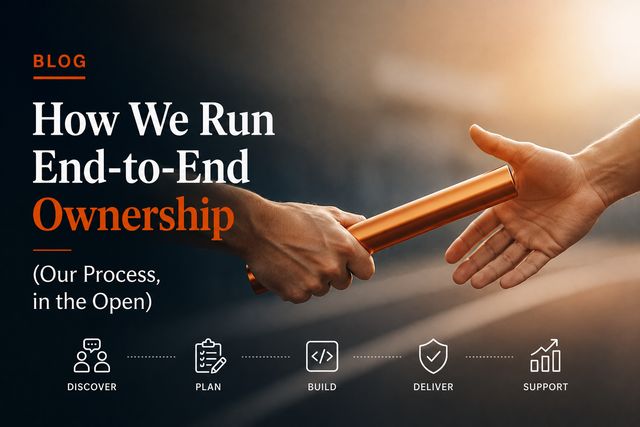
Our end-to-end software development process means one senior team owns the whole product, from scoping and design through building, shipping and support, with no hand-offs between separate groups. One team is accountable for the outcome, you talk to the engineers building it, and the price is on the page. There is no secret method here, which is the point. This is how we work, written out in the open, so you can judge it before you ever talk to us.
What end-to-end ownership actually means
"End-to-end" is a phrase a lot of agencies use and few honour. For us it has a specific meaning: the same team that scopes your product designs it, builds it, ships it and supports it. No throwing a spec over the wall to a separate build team. No handing a finished build to a support team that has never seen the code. One group carries the product the whole way.
The reason this matters is simple. Hand-offs are where intent gets lost and accountability quietly disappears. When work passes between groups, each one understands a little less of why, and when something breaks, everyone can point at someone else. With one accountable team there is no one to point at, which concentrates the mind wonderfully. It is also why founders choose India for software development through a senior team rather than the cheapest shop: the model matters as much as the rate.
The process, step by step
Here is the actual shape of a project with us. It is deliberately ordinary, because reliable beats clever.
- Scope, honestly. We start by narrowing to the smallest version that proves the idea, and we tell you what to cut. A tight scope is the cheapest risk reduction there is.
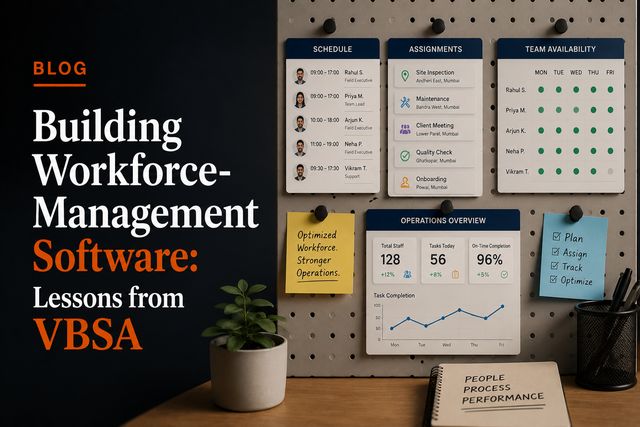
- Design around the real workflow. We model how the work actually happens before designing screens, the same discipline behind building workforce-management software, where the data model came before the dashboard.
- Build in the open. You see progress continuously and talk to the engineers writing the code. There is no account manager translating between you and the build.
- Ship something real early. We get a usable version in front of real users quickly, then iterate on what they actually do rather than what a roadmap guessed.
- Support what we shipped. The team that built it maintains it, so fixes come from people who understand the code, not strangers reading it for the first time.
Why we put the price on the page
Most software pricing is a negotiation designed to find the most you will pay. We do the opposite: we bill from about $20 an hour, the rate is on the page, and the scope is agreed up front. Transparent pricing is not just a nicety; it is a signal. A team willing to state its rate plainly is usually honest about scope and timelines too, because it has nothing to hide in the quote.
This also keeps the relationship clean. There is no padded estimate, no surprise change-order culture, no hidden account-management layer baked into the bill. You can read more about who we are and how we think on our about page. The honest version of offshore is the whole proposition, and pricing is where it starts.
You talk to the engineers
The single best predictor of a build that matches what you meant is direct contact with the people building it. So that is how we run it: you talk to the engineers, not a go-between. When a question comes up, it goes to someone who can actually answer it, and a real person replies within 15 minutes during working hours.
This sounds small and is not. Every layer between a founder and the build is a place for intent to leak. Removing those layers is most of why our work lands closer to what clients had in mind, and it is a core part of what we describe on our about page.
What it looks like in practice
This process is not theory. It is how we have built across very different domains since 2015, more than 320,000 hours of work, with one accountable team each time:
- For VBSA, a CRM dashboard and field mobile app that replaced spreadsheets for manpower allocation and large-scale resource planning.
- For Nova Mark, a platform that streamlines answer-paper checking and evaluator workflows for institutions.
- For The 3-20 Way, a website and mobile app that helps older adults improve mobility and strength through guided daily routines.
Operations software, an EdTech platform, a consumer health app, three industries, one way of working. You can see them all on our work page.
The honest limits
End-to-end ownership with a small senior team is not the answer to everything, and pretending otherwise would betray the whole point of writing this in the open. We are a focused team, not a thousand-person body shop, so we are a poor fit if you need dozens of engineers next week. And while we offer good overlap with UK and European hours and a workable window with the US, we are not in your timezone. We agree overlap hours up front and treat the gap as work continuing while you sleep, but it is a real trade-off, not a magic one.
How to start
If this way of working fits how you want to build, the next step is small. We start with a short, well-scoped piece of work, because a paid trial tells you more than any pitch. You talk to the engineers, the price is on the page, and you can cancel anytime. Read more about us on the about page, and if it sounds like the team you have been looking for, that is exactly how we built The Contrast to feel.
FAQ
Quick answers.
What does end-to-end software development mean?
It means one team owns the whole product, from scoping and design through building, shipping and support, with no hand-offs between separate groups. One team is accountable for the outcome, not just their slice.
Why does end-to-end ownership matter for founders?
Because hand-offs are where intent gets lost and accountability disappears. When one team owns everything, there is no finger-pointing and the people who scoped the work are the people who ship it.
Do I talk to the actual engineers?
Yes. You talk directly to the people building your product, not an account manager relaying messages. Direct contact is the single best predictor of a build that matches what you meant.
How is the pricing structured?
Transparently. We bill from about $20 an hour with the rate and scope agreed up front and on the page. A real person replies within 15 minutes and you can cancel anytime.